George Edwin McNeill Quotes
There is no mutuality of interests ... between capital and labor. It is the iron heel of a soulless monopoly, crushing the manhood out of sovereign citizens.
George Edwin McNeill, 1837-1906, Chief Organizer, Massachusetts Knights of Pythias, Quoted in John A. Garraty, The New Commonwealth: 1877-1890
Sourced by: Eigen's Political and Historical Quotations

At the time, it did seem impossible that labor and capital would ever have harmonious relations. But the notion that slavery would solve the problem is as preposterous as anything ever entered into the American political dialogue. But there were many in the South, and some in the North, who actually believed it. Even 150 years later, while labor and capital relations were much better than pre Civil War, they still could not be described as “harmonious” or “friendly”.


Webster was taking regular bribes from large corporations and even complained when his payments were late. So he might have had a pro-large business bias. At the time taking bribes even if there was a quid pro quo was not illegal or even “unethical” by then Congressional rules.


Roosevelt was awarded the Nobel Peace Prize for his peacemaking in the Russo-Japanese War.


Money was backed by gold then and therefore limited and the country was growing, and needed more money to finance development. But the only way to then have more money in circulation was for the government to borrow it from the people who had it—mostly wealthy people in the East and in England. These gold owners charged very high interest rates. However there was much more silver in the U. S. and more was being mined every day. So for many populists, the answer was to make silver a basis for money. But those who had gold backed money wanted to maintain the shortage of currency in the growing nation The populists naively thought that if there was sufficient money supply all other problems like labor strife would disappear. Some did when the money supply was finally expanded, but it was no panacea.


Jefferson was one of the first political and economic thinkers to express concern over the “wage slave” concept of the industrial revolution. This was one of the major reasons that he was not in consonance with Alexander Hamilton in his economic vision for America. While we followed the Hamilton direction, there are still issues of maintaining freedom and independence for an employee in modern nations and economies.

This quotation and other material were so radical and inflammatory that Calhoun wrote and published this anonymously.
This quotation is interesting for two reasons. First it is a good example of the twisted logic of some of the Slavery apologists who claimed that the Negro slave was better off than the free wage earner. The second reason is that it illustrates the norms of the treatment of the working man before the Civil War. The union movement would change the situation for the free laborer over the next century and then holidays and worker rights became normalized in American society. See {641290} for another of his absurd arguments.
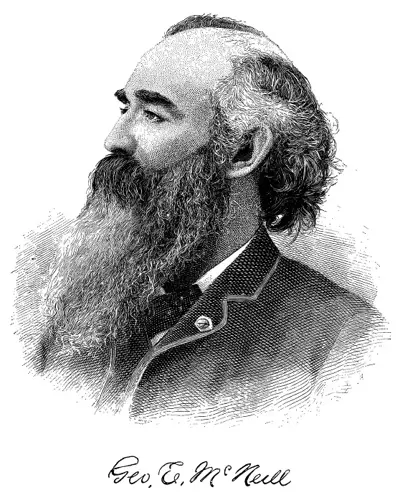
George Edwin McNeill (1836–1906), was an American mill worker, labor leader, and writer. McNeill is best remembered for a pioneering study of the American labor movement, The Labor Movement, or, the Problem of To-day, published in 1892.
