Vannevar Bush Quotes
There is a growing mountain of research. But there is increased evidence that we are being bogged down today as specialization extends. The investigator is staggered by the findings and conclusions of thousands of other workers— conclusions which he cannot find time to grasp, much less to remember, as they appear. Yet specialization becomes increasingly necessary for progress.
This was in 1945 where the number of research studies published each month was large compared to the past but a tiny fraction of what it would be just 50 years later.
Vannevar Bush, 1890-1974, Presidential Science Advisor (FDR), As We May Think, 1945
Sourced by: Eigen's Political and Historical Quotations

Bush had advised FDR to go ahead with the research and development program to try and develop an atomic bomb. He was the only Government Official who Roosevelt discussed the idea with. At the time, Bush as a government official supervised and directed many thousands of scientists, and was one of just a few scientists who monitored and advised on the Manhattan Project to develop the Bomb. Here he is one of the first people to notice, understand and articulate the dilemma of specialization in science. To the degree it was a problem in 1945, it became a geometrically greater problem 65 years later satellites were capturing more high resolution of the universe every week than all the astronomers in the world could examine in a year. Ironically, Bush called for a type of precursor to the Internet to cope with this problem which the Internet helped with. Using computers to observe and analyze the many images helped much but all of science became weighed down with this problem of specialization and the explosion of knowledge.


It is not only the companies of rich nations that equip their people, but also the non-profit sector including the universities.

This quotation illustrates the largest difference between politicians and scientists. Politicians are always seeking data and confirmation that their ideologies and theories are right. Scientists are always trying to prove the status quo wrong as this is the only way to increase knowledge. Newton showed that the Greeks were wrong and could not explain all of mechanics. Einstein proved that Newton was not quite right. The quantum mechanics scientists showed Einstein was not quote right with small particles and the Hicks Boson found a hole in quantum mechanics. This is progress in science—finding previous error or incompleteness.


Canute was a Scandinavian king who tried to control the ocean tides to show his power. In this particular case, the court ruled that new life forms could be patented.


Tesla was one of the great American immigrant scientists. He found in America the kind of intellectual and operational freedom that did not exist in the rigid, monarch-controlled, Austro-Hungarian Empire. He developed patents and techniques that formed the technological bases of radio, telephone long distance, TV, cell phones, Wi Fi, just to name a few. Most important he was Thomas Edison’s great nemesis. Edison invented DC electric generators that could power factories or entire streets in a neighborhood. Tesler invented and developed AC electrical technology which could power entire cities and he could move electricity over long distances which Edison could not. Tesler was one of the first scientists to conceive of and try to implement “Big Science” where there were huge capital investments to develop machines and systems to do what had never been done before—philosophically like the CERN Hadron Collider. Tesler even convinced a large corporation to finance the construction of a massive building and tower so he could experiment with the wireless transmission of electricity. However, as the industrial democracies have learned, Big Science can only be funded by governments and it often takes sever working in consort to afford the huge investment that is required. In Tesler’s era, the federal and state governments did not fund scientific research so his work was not only technically ahead of his time but also conceptually. He anticipated most of the problems and need for a national power grid that was challenging America even at the beginning of the 21st century.


He raised an intellectual alarm that scientists were generally ignorant of the liberal arts and non-scientists were scientifically illiterate. This was not good for society where both were needed for making public policy and developing our society. He was quite influential in British and American higher education where many colleges added required science courses to liberal arts curricula and vica versa. However by the 21st century, the sciences had advanced at such a rapid pace, that the taking of a few college level science courses was not sufficient to produce a scientific literacy, and the problem was no better than in the 1950s.


The English Language has been in use for over 1000 years. English and English Speaking scientists have been active througout that time. Yet at the time that Wulf pointed this out, the actual word "Scientist" had been in use for less than a century.


Sir Humphry was a religious man, and yet he focused on one of the great differences between science and religion. The latter is presumed true and eternal by its faithful, while science is never such. No truth is eternal in science and rarely does a scientific “truth” last 100 years without modification, elaboration or additional complexity. This is one of the reasons that scientists make poor witnesses at Congressional hearings. They are never certain of anything if they are good scientists. Witnesses from other fields testify with much more certainty as they are motivated by self interest or ideology where doubt is unacceptable.

Scientific breakthroughs depend on genius, circumstances, the work of others and serendipity. None of these are very predictable which is why it is do difficult to manage a scientific enterprise and be accountable for any results. See {624867}.
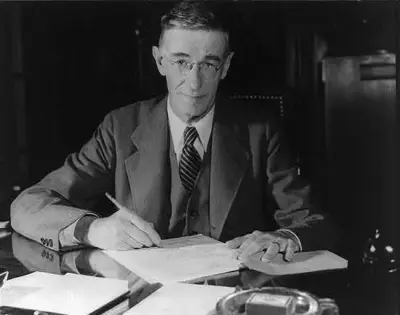
Vannevar Bush was an American engineer, inventor and science administrator, who during World War II headed the U.S. Office of Scientific Research and Development (OSRD), through which almost all wartime military R&D was carried out, including important developments in radar and the initiation and early administration of the Manhattan Project. He emphasized the importance of scientific research to national security and economic well-being, and was chiefly responsible for the movement that led to the creation of the National Science Foundation.
