Nikola Tesla Quotes
The scientific man does not aim at an immediate result. He does not expect that his advanced ideas will be readily taken up. His work is like that of the planter — for the future. His duty is to lay the foundation for those who are to come, and point the way.
Tesla was one of the great American immigrant scientists. He found in America the kind of intellectual and operational freedom that did not exist in the rigid, monarch-controlled, Austro-Hungarian Empire. He developed patents and techniques that formed the technological bases of radio, telephone long distance, TV, cell phones, Wi Fi, just to name a few. Most important he was Thomas Edison’s great nemesis. Edison invented DC electric generators that could power factories or entire streets in a neighborhood. Tesler invented and developed AC electrical technology which could power entire cities and he could move electricity over long distances which Edison could not. Tesler was one of the first scientists to conceive of and try to implement “Big Science” where there were huge capital investments to develop machines and systems to do what had never been done before—philosophically like the CERN Hadron Collider. Tesler even convinced a large corporation to finance the construction of a massive building and tower so he could experiment with the wireless transmission of electricity. However, as the industrial democracies have learned, Big Science can only be funded by governments and it often takes sever working in consort to afford the huge investment that is required. In Tesler’s era, the federal and state governments did not fund scientific research so his work was not only technically ahead of his time but also conceptually. He anticipated most of the problems and need for a national power grid that was challenging America even at the beginning of the 21st century.
Nikola Tesla, 1856–1943, Serbian Born Physicist, Inventor & Electrical Engineer, "Radio Power Will Revolutionize the World", Modern Mechanics and Inventions, July 1934
Sourced by: Eigen's Political and Historical Quotations


This quotation became the mantra of the MIT Media Lab's Professor Hugh Herr and others whose total efforts are spend inventing things for the future.


This is why the American Government has played such a major role in most of the great technologies in American History. Interchangable Parts (A federal contract with Eli Whitney), Canal Construction (New York State built the Erie Canal), the Railroad (federal government gave hugh tracts of land to build the rail lines to the West), the Telegraph (No one would use it until the government financed the experiment to prove it by creating a line between Baltimore and Washington), AC Electricity, there the city of Rochester NY hired Tessler and Westinghouse to Demonstrate Generating Electricity at Niagra Falls and transmitting it over 20 miles which Edison’s Direct Current could not do), immunization (the Army Medical Corps gave the first grants to universities to develop the science of vaccines and immunization, the computer (in WWII the U. S. financed the development of computers sent to England to implement Turing’s breaking of the German “unbreakable” code), atiomic energy (the Manhattan Project—the largest scientific endeavor the world has known), the Internet (Developed with long term research funds for DARPA the future technology research arm of the Defense Department. American investors and businesspeople took each of these and developed them but the initial steps, when no capitalist dared risk on such basic and futureistic efforts were taken by American Government which probably could never have developed these technologies but the private sector could not do it with government in the role Moritz herein describes.


This was in 1945 where the number of research studies published each month was large compared to the past but a tiny fraction of what it would be just 50 years later.

Scientific breakthroughs depend on genius, circumstances, the work of others and serendipity. None of these are very predictable which is why it is do difficult to manage a scientific enterprise and be accountable for any results. See {624867}.

Sir Humphry was a religious man, and yet he focused on one of the great differences between science and religion. The latter is presumed true and eternal by its faithful, while science is never such. No truth is eternal in science and rarely does a scientific “truth” last 100 years without modification, elaboration or additional complexity. This is one of the reasons that scientists make poor witnesses at Congressional hearings. They are never certain of anything if they are good scientists. Witnesses from other fields testify with much more certainty as they are motivated by self interest or ideology where doubt is unacceptable.

Many of his greatest ideas were not sufficiently appreciated by many other scientists nor the businessmen who funded scientific projects then. Tesla was one of the great American immigrant scientists. He found in America the kind of intellectual and operational freedom that did not exist in the rigid, monarch-controlled, Austro-Hungarian Empire. He developed patents and techniques that formed the technological bases of radio, telephone long distance, TV, cell phones, Wi Fi, just to name a few. Most important he was Thomas Edison’s great nemesis. Edison invented DC electric generators that could power factories or entire streets in a neighborhood. Tesler invented and developed AC electrical technology which could power entire cities and he could move electricity over long distances which Edison could not. Tesler was one of the first scientists to conceive of and try to implement “Big Science” where there were huge capital investments to develop machines and systems to do what had never been done before—philosophically like the CERN Hadron Collider. Tesler even convinced a large corporation to finance the construction of a massive building and tower so he could experiment with the wireless transmission of electricity. However, as the industrial democracies have learned, Big Science can only be funded by governments and it often takes sever working in consort to afford the huge investment that is required. In Tesler’s era, the federal and state governments did not fund scientific research so his work was not only technically ahead of his time but also conceptually. He anticipated most of the problems and need for a national power grid that was challenging America even at the beginning of the 21st century.


Most scientists do not have the skill or the totality of knowledge to accurately predict the effect of scientific research and learning on society. Many are not interested. Those who try to communicate with politicians and the public are usually met with indifference or suspicion. Above all, the scientific and mathematical literacy of the public is so weak, that it is impossible in much of science to even explain the science to the lay public much less explain its implications. Soddy was a bit of an idealist from a class society and he felt the upper classes should be better informed by scientists.
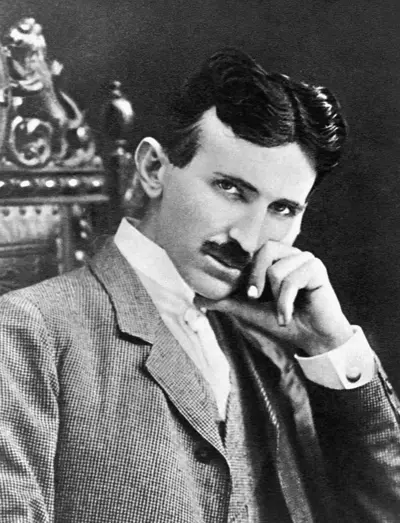
Nikola Tesla was a Serbian-American inventor, electrical engineer, mechanical engineer, and futurist best known for his contributions to the design of the modern alternating current (AC) electricity supply system.
