Vannevar Bush Quotes
… we are being bogged down today as specialization extends. The investigator is staggered by the findings and conclusions of thousands of other workers—conclusions which he cannot find time to grasp, much less to remember, as they appear. Yet specialization becomes increasingly necessary for progress, and the effort to bridge between disciplines is correspondingly superficial.
Bush had advised FDR to go ahead with the research and development program to try and develop an atomic bomb. He was the only Government Official who Roosevelt discussed the idea with. At the time, Bush as a government official supervised and directed many thousands of scientists, and was one of just a few scientists who monitored and advised on the Manhattan Project to develop the Bomb. Here he is one of the first people to notice, understand and articulate the dilemma of specialization in science. To the degree it was a problem in 1945, it became a geometrically greater problem 65 years later satellites were capturing more high resolution of the universe every week than all the astronomers in the world could examine in a year. Ironically, Bush called for a type of precursor to the Internet to cope with this problem which the Internet helped with. Using computers to observe and analyze the many images helped much but all of science became weighed down with this problem of specialization and the explosion of knowledge.
Vannevar Bush, 1890-1974, Director of the U. S. Office of Scientific Research and Development, Vice President of MIT and Dean of the MIT School of Engineering, Founder of Raytheon, Presidential Science Advisor (Franklin Delano Roosevelt), “As We May Think”, July 1, 1945
Sourced by: Eigen's Political and Historical Quotations

This was in 1945 where the number of research studies published each month was large compared to the past but a tiny fraction of what it would be just 50 years later.


This was a radical speech for the time, suggesting reforms that had been unthinkable to most Turks. Although it is not prohibited by the Koran and early Islamic artists made some of the greatest paintings and depictions of people, fundamentalists gained control of Islam and interpreted any statue as an idol that could be worshipped and this generalized to Islamic art in general where people ceased to be depicted and even animal depictions were rare. Muslim art developed incredible geometric intricacy but tended not to depict anything that is real. This extended to photography and illustrations in books including textbooks. At the same time, not unlike some Christian and Jewish Fundamentalists, the Muslim fundamentalists opposed science and the teaching thereof on the grounds that all authentic knowledge was in the Koran and anything else was not only false but also heretical. So this speech was a type of “declaration of war” against the established religious order and culture.


By symbols be was not only referring to metaphorical symbols of letters, words, digrams, numbers and formulas. The vast majority of all human knowledge is spread by symbols of one kind or another. The must sophisticated devices or weapons all boil down to sets of words, formulas and diagrams. Art is almost all symbolic.


This declaration, drafted by Russell and Einstein two days before Einstein’s death was signed by a number of other prominent scientists.


Many important breakthroughs emanated from scientific curiosity of some scientist who was not thinking of any practical application at all.


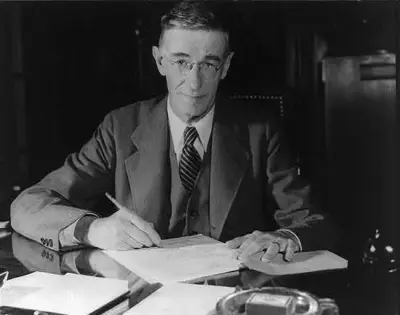
Vannevar Bush was an American engineer, inventor and science administrator, who during World War II headed the U.S. Office of Scientific Research and Development (OSRD), through which almost all wartime military R&D was carried out, including important developments in radar and the initiation and early administration of the Manhattan Project. He emphasized the importance of scientific research to national security and economic well-being, and was chiefly responsible for the movement that led to the creation of the National Science Foundation.
