Roger Williams Quotes
There goes many a ship to sea, with many hundred souls in one ship, whose weal and woe is common, and is a true picture of a commonwealth or a human combination or society. It hath fallen out sometimes that Papists, Protestants, Jews, and Turks may be embarked in one ship; upon which supposal I affirm that all the liberty of conscience that ever I pleaded for turns upon these two hinges: that none of the Papists, Protestants, Jews, or Turks be forced to come to the ships prayers or worship, nor be compelled [restrained] from their own particular prayers or worship, if they practice any.
Williams, Roger. "Letter to the Town of Providence, January 1655." The Letters of Roger Williams, edited by John Russell Bartlett, Providence Press Company, 1874.


It was drafted by John Adams. Note that there was freedom of religion for Christians and not others. Of all the colonies, Massachusetts had the worst record of religious intolerance with Puritans controlling everything. Rhode Island and Connecticut were created by religious dissenters from Massachusetts. Adams had all he could do to get the Christian sects on an equal footing ratified. The other colonies however, insisted to a total freedom of religion clause which became the First Amendment to the national Constitution. Adams himself was a kind of secular, cultural Christian who did not believe in the divinity of Christ and other Christian doctrine. See {592695} to illustrate this.


This was in effect a “Real Estate Promotional Document. Unlike the New England colonies the Carolinas had freedom of and from religion right from the beginning and it was used as an advertising point to get colonists. See {611573} and {611571} for other “features.”

At first this clause appears to be very enlightened and establishing freedom of conscience. This clause allowed Catholics to practice freely whereas in other colonies they could not. However, as one reads on, it becomes clear that the “tolerance” is limited to Christians only. Then if one examines the exception within the parentheses and refer to the rest of the act—see {611994}—, one finds that even Christians who have certain theological beliefs are to be put to death—those for example who deny the holiness of the Trinity such as Unitarians who were a major group in the New England Colonies. It was a significant step at the time however to protect Roman Catholics.

Those who claim that the founding fathers contemplated religion as a critical component of government often point to this article of the South Carolina Constitution. However, they ignore the almost simultaneous passage of the New York constitution as in {612166}. When the framers of the Constitution met in 1787 in Philadelphia the separation of church and state issue was not really resolved and awaited the Bill of Rights where the separatists won out.


Jinnah, although insisting on a Muslim state, was a modernist and assumed that there would be freedom of religion. To a certain extent he believed in separation of church and state. However, after his death Pakistan has moved ever further towards a strict adherence to Sharia and Islamic law.


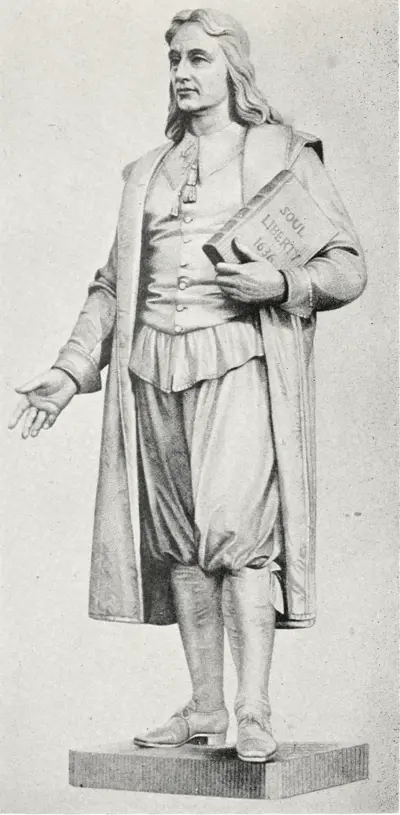
Roger Williams was a Puritan minister, theologian, and author who founded Providence Plantations, which became the Colony of Rhode Island and later the U.S. state of Rhode Island. He was a staunch advocate for religious freedom, separation of church and state, and fair dealings with Native Americans.
