Neil deGrasse Tyson Quotes
There are no wild, seedless watermelons. There's no wild cows... You list all the fruit, and all the vegetables, and ask yourself, is there a wild counterpart to this? If there is, it's not as large, it's not as sweet, it's not as juicy, and it has way more seeds in it. We have systematically genetically modified all the foods, the vegetables and animals that we have eaten ever since we cultivated them. It's called artificial selection.
Tyson, Neil deGrasse. Interview. StarTalk Radio.


Actually, while such selective breeding is possible in all animals, the selection for a single trait almost always produces other unintended and unanticipated traits and these could be devastating to the “new generation”, unpleasant, benign, or anything else. At the time selective breeding was the only possible tool to produce “desirable” traits in an animal or to eliminate what someone things of as “undesirable” traits. Today, our understanding of the human genome and genetic engineering offers a much more reliable possibility of affecting animal traits without as many risks of random and unintended consequences that are present with breeding.
He and others have already done it. Joyce's lab at the Scripps Research Institute was the first to produce a self-replicating in vitro system, capable of exponential growth and continuing evolution, composed entirely of RNA enzymes. Most politicians do not understand much about evolution and many actually believe that evolution has not been proven an is not what governs the development of species. And at some point these men and women will have to come to grips with this scientific reality and decide what if any restrictions there should be on the human control and manipulation of the evolution of different species.

What he thought was conceivable in the 1970’s seemed almost certain to come to pass 30 years later. Scientists had already altered the evolution of various plants and animals, and the complete human genome had been sequenced. The question will be not whether man will be able to control and modify his own evolution, but how should this be done and who should decide it. We have realized that man has already—unintentionally—altered the evolution of many species from passenger pigeons which are now extinct and the dog which coevolved with humans. Arguably, man’s development of the ability to control his own evolution is an evolutionary development itself. One great question for society is whether it is better to alter evolution unknowingly or in a planned, relatively controlled manner. For man to participate in the design of human evolution will be the nightmare of the Creationists who insist that evolution is too complicated to be somewhat of a random process and that there must be a designer who they assume is God. When man becomes the designer, that will be very disturbing. For most theologians, there will be little difficulty with the notion that God chose the mechanism of evolution and chose humans to give the intellect and knowledge to implement and design the evolutionary process.


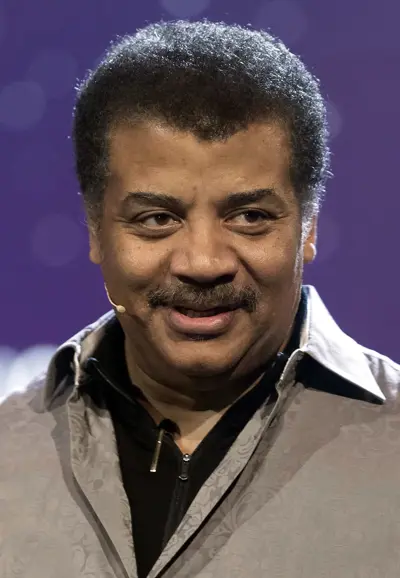
Neil deGrasse Tyson is an American astrophysicist, planetary scientist, author, and science communicator.
