ELIZABETH BLACKBURN
(Elizabeth Helen Blackburn)
As one of the few working scientists on the commission she provided much of the information on current science and unmasked some of the “junk science” that was presented by the committee staff. When the commission was asked to vote on a ban on all cloning including prohibiting stem cell research in conformity to President George W. Bush’s position, she led a majority voting against the ban. To salvage the situation, the Chairman then modified the proposed resolution to call for a 4 year moratorium on such research and get a narrow majority. Shortly thereafter Blackburn and two others who had had different views from the President were fired by the White House and replaced by three members whose views leaned in the opposite direction. See Commission Chairman Kass {611735} for the views that were acceptable to the White House.
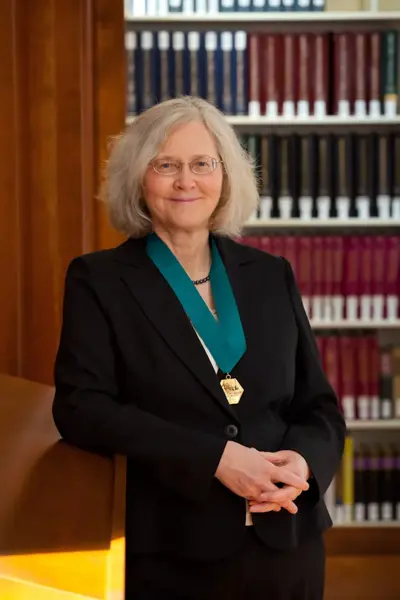
Elizabeth Helen Blackburn, AC FRS FAA FRSN is an Australian-American Nobel laureate who is the former President of the Salk Institute for Biological Studies. Previously she was a biological researcher at the University of California, San Francisco, who studied the telomere, a structure at the end of chromosomes that protects the chromosome. In 1984, Blackburn co-discovered telomerase, the enzyme that replenishes the telomere, with Carol W. Greider. For this work, she was awarded the 2009 Nobel Prize in Physiology or Medicine, sharing it with Greider and Jack W. Szostak, becoming the first Australian woman Nobel laureate. She also worked in medical ethics, and was controversially dismissed from the Bush Administration's President's Council on Bioethics.
