Elizabeth Blackburn Quotes
that's an incredibly hopeful message for us humans to be receiving from pond scum, because it turns out that as we humans age, our telomeres do shorten, and remarkably, that shortening is aging us. Generally speaking, the longer your telomeres, the better off you are. It's the overshortening of telomeres that leads us to feel and see signs of aging. My skin cells start to die and I start to see fine lines, wrinkles. Hair pigment cells die. You start to see gray. Immune system cells die. You increase your risks of getting sick. In fact, the cumulative research from the last 20 years has made clear that telomere attrition is contributing to our risks of getting cardiovascular diseases, Alzheimer's, some cancers and diabetes, the very conditions many of us die of.
Elizabeth Blackburn, Ted Talk, April 2017 at TED2017
Sourced by: Eigen's Political and Historical Quotations


Describing her research which led to the Nobel Prize.


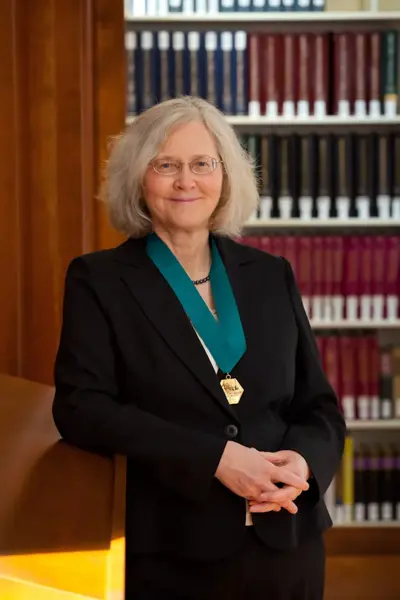
Elizabeth Helen Blackburn, AC FRS FAA FRSN is an Australian-American Nobel laureate who is the former President of the Salk Institute for Biological Studies. Previously she was a biological researcher at the University of California, San Francisco, who studied the telomere, a structure at the end of chromosomes that protects the chromosome. In 1984, Blackburn co-discovered telomerase, the enzyme that replenishes the telomere, with Carol W. Greider. For this work, she was awarded the 2009 Nobel Prize in Physiology or Medicine, sharing it with Greider and Jack W. Szostak, becoming the first Australian woman Nobel laureate. She also worked in medical ethics, and was controversially dismissed from the Bush Administration's President's Council on Bioethics.
