Elizabeth Blackburn Quotes
Now, remember that little pond scum critter Tetrahymena? The craziest thing was, Tetrahymena cells never got old and died. Their telomeres weren't shortening as time marched on. Sometimes they even got longer. Something else was at work, and believe me, that something was not in any textbook. So working in my lab with my extraordinary student Carol Greider -- and Carol and I shared the Nobel Prize for this work -- we began running experiments and we discovered cells do have something else. It was a previously undreamed-of enzyme that could replenish, make longer, telomeres, and we named it telomerase. And when we removed our pond scum's telomerase, their telomeres ran down and they died. So it was thanks to their plentiful telomerase that our pond scum critters never got old.
Elizabeth Blackburn, Ted Talk, April 2017 at TED2017
Sourced by: Eigen's Political and Historical Quotations


Describing her research which led to the Nobel Prize.
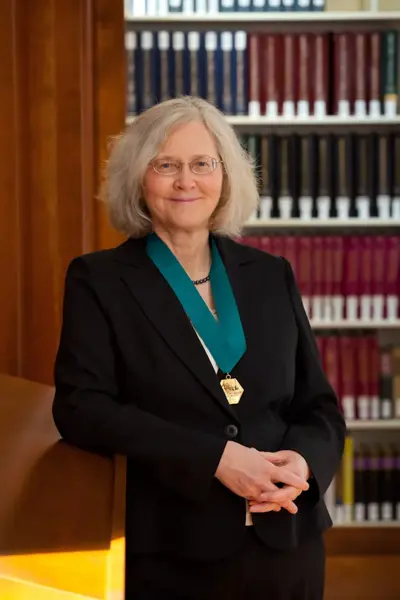
Elizabeth Helen Blackburn, AC FRS FAA FRSN is an Australian-American Nobel laureate who is the former President of the Salk Institute for Biological Studies. Previously she was a biological researcher at the University of California, San Francisco, who studied the telomere, a structure at the end of chromosomes that protects the chromosome. In 1984, Blackburn co-discovered telomerase, the enzyme that replenishes the telomere, with Carol W. Greider. For this work, she was awarded the 2009 Nobel Prize in Physiology or Medicine, sharing it with Greider and Jack W. Szostak, becoming the first Australian woman Nobel laureate. She also worked in medical ethics, and was controversially dismissed from the Bush Administration's President's Council on Bioethics.
