Helen Herron Taft Quotes
The woman’s voice is the voice of wisdom and I can see nothing unwomanly in her casting the ballot.
Although Campaigning in the heart of the conservative Midwest, she had no compunction about advocating women’s suffrage.
Helen Herron Taft, 1861-1943, First Lady, Statement, De Moines, Iowa, November 13, 1908
Sourced by: Eigen's Political and Historical Quotations


Howe said women should be officially deprived of the ballot because of this reason.

The editorial was in support of women’s suffrage—the right to vote which at the time women did not have in Britain. Women were very active in protests and demonstrations. Tactics sometimes involved civil disobedience and chaining themselves to public buildings. It was the civil disobedience and disruptions that the newspaper referred to as the “follies and excesses.” In retrospect today, it is amazing how threatened the society felt and how they reacted to the “threat” of females voting. It does however give us a perspective on those contemporary societies which restrict women’s voting rights.


Although liberal on many other issues, women voting was anathema to him.


The concept of taxpayers being entitled to vote to avoid taxation without representation was fundamental to the Founding Fathers. However, the only people who paid taxes were those who owned property as there was no income tax at the time. Since the male controlled the family property, not allowing women to vote did no injury to the basic principle. However, the sexist attitude of the times ran up against this basic principles in the case of widows and unmarried women who owned property. Faced with this contradiction, some of the Founding Fathers like Lee actually favored the voting franchise for women who were widows and property owners or even unmarried female property owners. There were not enough people who saw this contradiction so that all women were originally prohibited from voting, but this quotation shows that it was a political issue at the time.


Many people, mostly men, tended to regard and label the militant suffragettes as extremists and allowed as how women who advocated their voting rights but in an acceptable way might be wrong but they were at least ladies. The same kind of attempted split occurred in the latter half of the 20th century over the Woman’s movement. The Feminists were not “ladies” and were not to be emulated by normal women even if they had sympathy for he views. Groups without power have always been acceptable to society as long as their cries for a share of power were ineffectual and did not disrupt the existing order. But when they begin to use more successful means and are heard and attended to, then they are labeled as extremists not to be emulated by “decent” people.


Hunt gave as an example Mary Smith of Stanmore. This quotation is very interesting in the history of women’s suffrage. Hunt was a strong advocate for Universal Suffrage (See {616653}.) At the time, even men had to be a taxpayer and own a sufficient amount of property to vote. Less than 20% of the population of Britain were allowed to vote. The argument at the time was that the husband would represent the family’s interest at the ballot box and there was no need for women to vote. But by facing parliament with the logical inconsistency of its position, he was able to make his point, although there were very few women like Mary Smith who were single and had the economic resources to qualify. Most widows remarried so even if they had economic resources, there was a man who could assume the then perceived role of head of the household.


Woodrow Wilson had just finished speaking to the convention – see {638532}. This statement was thought be some to be insulting to the President who said he favored the right of women to vote, but did very little if anything to make that happen. Although Shaw was an ordained Methodist Minister, the Methodist Episcopal Church refused to allow her to preach because of her suffrage views.

First woman elected to Congress. Women could vote in Montana years before women had the right to vote nationally. Women pioneers were critical contributors to an extremely hard life. Many widows and single women ran farms and ranches, fought raiding Indians, and married pioneer women were necessary to survival.


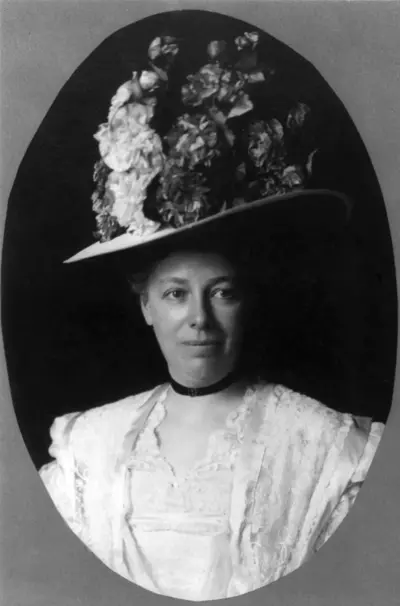
Helen Louise Taft was the wife of William Howard Taft and the First Lady of the United States from 1909 to 1913.
