Woodrow Wilson Quotes
The United States must be neutral in fact as well as in name.... We must be impartial in thought as well as in actiona nationthat neither sits in judgment upon others nor is disturbed in her own counsels and which keeps herself fit and free to do what is honest and disinterested and truly serviceable for the peace of the world.
Wilson, Woodrow. "Message on Neutrality." 19 Aug. 1914. The Public Papers of Woodrow Wilson: The New Democracy, edited by Ray Stannard Baker and William E. Dodd, vol. 1, Harper & Brothers, 1926, p. 157.


The plan was to have an American agent with a few marines make an alliance with a rival to the throne of Algiers and depose the existing ruler with American “special forces”.

3rd Earl Russell of Kingston. The military weak nations agreed with him, but the militarily strong ones did not—especially America and England which had the Atomic Bomb when others did not.

The Republican controlled Senate had turned down the ratification of the League of Nations presented by Democratic President Wilson, and looked like they would turn down any international treaty even if presented by a Republican President. This statement allowed the treaty ratification by only a few votes. However, after that the Senate turned down our participation in the Permanent Court of Arbitration at the Hague. See {640099}.

The Congressman was being critical of the George W. Bush Administration and their tendency to decide which leaders and countries were legitimate and moral and which were not, and then invading the “bad” and executing the leaders as with Iraq and Saddam Hussein.


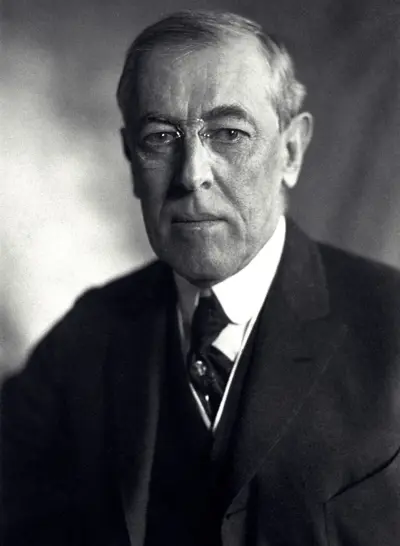
Thomas Woodrow Wilson was an American politician and academic who served as the 28th president of the United States from 1913 to 1921. A member of the Democratic Party, Wilson served as the president of Princeton University and as the 34th governor of New Jersey before winning the 1912 presidential election. As President, Wilson led the United States into World War I in 1917. He was the leading architect of the League of Nations, and his progressive stance on foreign policy came to be known as Wilsonianism. Scholars have generally ranked Wilson in the upper tier of U.S presidents, although he has been criticized for supporting racial segregation and white supremacy.
