Catherine the Great Quotes
The Treaty of Kuchuk Kaynarca [1774] is a success the like of which Russia has never had before.
The treaty followed an aggressive military policy of Russia against the Ottomans on several fronts. Turkey then granted independence to the Crimea and ceded control of several key ports to Russia. This treaty was seen as a major humiliation of the Ottoman Empire and marked a turning point in the relations between Europe and the Middle East.
Catherine II ("The Great"), 1729-1796, Empress of Russia, 1774
Sourced by: Eigen's Political and Historical Quotations

See {640105} and {640104} for more about the Capitulations Treaty.


The Ottoman Turks had conquered much of Europe, as far even as Vienna. Ataturk although an incredible reformer for democracy, religious freedom, and gender equality, felt that critical to Turkey’s independence and ability of engage in radical reform depended on the World and European and Turkish perception that Turkey was the equal of any European nation and had ruled most at one point.

At the time Dulles was the Assistant Secretary & Near East Division chief of the State Department. The Turks were killing, starving and displacing Armenians—Mostly Christians—in Turkey. Like modern ethnic cleansing and genocides such as Kosovo, Rwanda, and Sudan, the magnitude of the atrocities was denied by the perpetrators and their apologists and other countries did not want to publicly admit the genocide lest they be forced to intervene by public opinion. Previously, the Armenians had slaughtered many Turks, especially the Armenians allied with Russia, and the two groups to this day have a continued distrust of each other—see {51838}, {638251}, {620602}, {620603}, {620604}, {620605}, {620600}, and {620606}


Turkey, in a disastrous foreign policy decision unilaterally withdrew from a major treaty and joined Germany in WWI in exchange for German support of Turkey’s treaty withdrawal. It led to the dissolution of the Ottoman Turkish Empire when Germany was defeated in WWI. Historically, it shows how easy it is for a nation to abrogate a treaty which illustrates how ephemeral treaties actually are. See De Gaulle’s wonderful quotation on this point—{138034}.
England in this quotation claims the right to interfere in the internal affairs of another nation if there is mismanagement or crises AND her national interests are affected.


This was typical of a free trade agreement of the time. It also provided that Englishmen residing for trade in the Ottoman Empire be free of Ottoman poll and head taxes. The Ottomans had such arrangements with France and Venice—then an independent city. In addition to the trade advantages, the Ottomans were militarily concerned with Spain and the English-Spanish hostility was supported and welcomed by the Ottomans. See Murad’s 1590 letter to Queen Elizabeth.

The basic treaty sold some of Ethiopia’s colonial territory (Eritrea and Tigray) to Italy in exchange for arms. Italy had tried to conquer the area but lost 500 men in the Battle of Dogali. However, after this peace treaty, Italy maintained that Article 17 of the treaty gave them the right to declare Ethiopia an Italian Protectorate which they did. However, there were two different versions of the treaty that the Italians had drawn up—one in Italian, the other in Aramaic. Britain, Belgium and Germany supported Italy; France, Turkey and Russia supported Ethiopia. Menelik then, to make matters clear, repudiated the treaty in 1893. Italy send an invasion force that was soundly thrashed by the Ethiopians setting the stage for the Italian attack on Ethiopia in World War II years later. Parties to International treaties thereafter have paid close attention to the different language versions.


Theis was the phrase he used to describe the collapse of the Soviet Union. This and other statements he made about the breakup of the Russian empire, together with his actons reagading foreign affairs, led many Western observers to think that Putin was trying to build up Russia to be amajor World Power as it was relatively recently. This annual address to the Duma has the importance of the United States' President with the State of the Nation Address. Every phrase and sentence is very carefully crafted. Also see Quotation 644184 under Related Quotes foir a more explicit statement,

The “proofs” were diplomatic assurances—treaties—that England would guarantee the territorial integrity of Belgium. The British made strong diplomatic efforts to persuade Germany not to occupy Belgium. The German’s none the less send armies in under the excuse that if they did not, the French would occupy the country and have a strategic advantage over them. Diplomacy could do no more good. England had to send troops or renege on its obligations. So England was in WWI.

The existing treaties of many of the different European countries like the NATO Treaty obliged them to assist their allies if they were involved in war. Once Austria attacked Serbia, Russia had to assist Serbia against Austria. Germany then joined with Austria and that triggered the treaty whereby France had to support Russia. And when Germany overran Belgium to attack France, England was obligated to come to Belgium’s defense. The only country that had planned for and wanted war was Germany who used her obligation to Austria as the excuse to implement her war plans (see {642092}). The entire Western World was at war when all but one nation wanted to avoid war. The communications and diplomacy of the time could not keep up with events and one of the worst wars in history ensued.


It was true that the majority of the citizens of Crimea in 2014 preferred to be a part of Russia than the Ukraine. So the Russians sized the Crimea, had an election and when the vast majority of the Crimeans voted for Russian affiliation, they annexed the Crimea under the principle of self-determination. However, Russia has two of its states with Muslim majorities that prefer to affiliate with one of the majority Muslim nations in the area. But the hypocrisy of the Russians became clear when they would not allow those two states to have elections. The Russian policy seemed to be that whatever is part of Russia is non-negotiable and not subject to self-determination, but whatever borders on Russia that is not part of Russia is entitled to an expression of self-determination and independence of other affiliation if they want. The Crimea had the only warm water port in the Soviet Union; they had a deal with the Ukrainians that their navy could use the port. However, they felt that Western support for the new Ukrainian government was the first step in ousting Russia from that port.
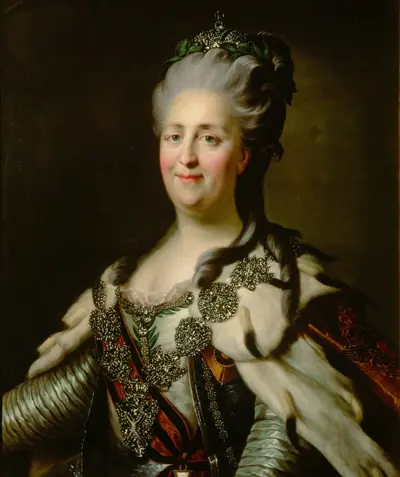
Catherine II, most commonly known as Catherine the Great, was empress regnant of All Russia from 1762 until 1796 – the country's longest-ruling female leader. She came to power following a coup d'état that overthrew her husband and second cousin, Peter III. Under her reign, Russia grew larger, its culture was revitalised, and it was recognized as one of the great powers of Europe.
