Tony Blair Quotes
The people’s priorities are our priorities. The people’s concerns are our concerns.
Tony Blair, British Prime Minister (Labor), Parliamentary debate shortly after coming to government
Sourced by: Eigen's Political and Historical Quotations


The speech was never actually delivered, but instead the Bishop published it. It received wide distribution including in America where it was published by the Maryland Gazette on September 29, 1774.


At the time the power and prestige of Congress relative to the Presidency , was much greater than it is today. It was McKinley’s successor, Theodore Roosevelt, who began a 20th century trend which led to a reversal of the relationship between the Executive Branch and the Legislative.


Samuel Langhorne Clemens, 1835-1910. Even in a democracy, governments often enact laws that the public disapproves of and fails to enact others that the public wants. Most taxes are examples of the former; gun control legislation, of the latter.


This constitution, 13 years later, became the basis for the national Batavian Constitution.


Cooke was a bitter foe of monarchy in general and not just of Charles I. His argument here is that when the people support a king, they are breaking the Biblical commandment of not worshipping idols. Thus God is against monarchy. See {634004} for another religious attack on monarchy.
_0_thumbnail_47x47.jpg "Statue of Robert Hall in Leicester.")
For many people the implication of this quotation is that there should be no government secrets withheld from the citizens who have the right to examine. Others argue that government may have temporary secrets to protect against foreign enemies for example, but that these must be declassified very promptly so that the citizens can examine the actions of their government in time to replace the government if they are not satisfied. Almost all government officials tend to reject the first implication out of hand, and grudgingly accept the second with their discretion controlling when declassification should take place. The problem of America is twofold. There is much over-classification (material kept secret that should not be at all), and the time till declassification is long in general and truly absurd in many cases. For example, there are documents from WWII that by 2013 had still not been declassified. See {591444}, {641317}, and {589105} for exemplar views. William Jennings Bryan introduced this principle into the American political dialogue. See {641027}.


Spinoza was one of the most feared intellectuals in human history—feared that is by the established power structures. He is the only known person who was excommunicated by the Catholics, the Jews and the Muslims—all were forbidden to read his works. He was the enemy of authority and advocated personal reason as the guide for men.

She had been accused of being a follower of public opinion rather than a driver of it as many politicians see themselves. At the time, she refused to stake out specific positions in her contest for the presidential nomination of her party—the socialists. She won the primary, the first such French woman, but lost in the general election.
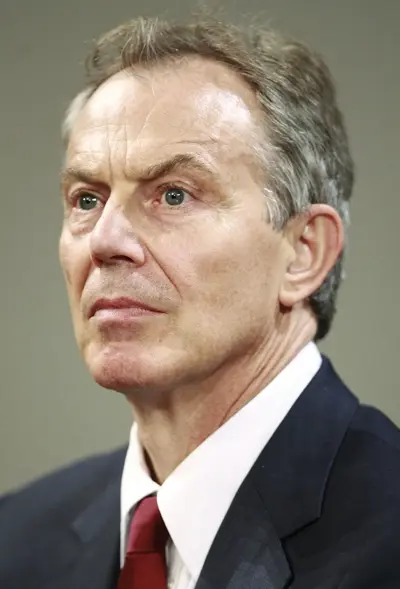
Anthony Charles Lynton Blair is a British politician who served as Prime Minister of the United Kingdom from 1997 to 2007 and Leader of the Labour Party from 1994 to 2007. On his resignation he was appointed Special Envoy of the Quartet on the Middle East, a diplomatic post which he held until 2015. He currently serves as the executive chairman of the Tony Blair Institute for Global Change, established in 2016. As prime minister, many of his policies reflected a centrist "Third Way" political philosophy. He is the only living former Labour leader to have led the party to a general election victory and the only one in history to form three majority governments.
