Leo Tolstoy Quotes
The oppression of a majority by a minority, and the demoralization inevitably resulting from it, is a phenomenon that has always occupied me and has done so most particularly of late …. The reason for the astonishing fact that a majority of working people submit to a handful of idlers who control their labour and their very lives is always and everywhere the same — whether the oppressors and oppressed are of one race or whether, as in India and elsewhere, the oppressors are of a different nation.
Tolstoy saw this as a much more general phenomenon than classic cases where the English dominated India. He not only included ethnic minorities (like the Chinese who dominate the economy of the Philippines or the Shiite-Sunni dominance battles in the Middle East, but he included a classic business situation where the minority (the wealthy owners and bosses) dominate and control the majority (the workers).
Leo Tolstoy, 1828-1910, Russian Writer & Philosopher, Letter to Yasnaya Polyana, December 14, 1908, (Often referred to as “Letter to a Hindu”)
Sourced by: Eigen's Political and Historical Quotations


The term “rugged individualism” was used at the time be very conservatives and the very wealthy to describe business leladers with words that had very good public connotations. They argued that it would be undesirable to curtail their individualism that was so important by any government regulations or laws that would limit what the business leaders could do. However, the reality was that these very successful and powerful “rugged individualists” had regimented most everyone else—employees, consumers, and small businessmen who might sell them services or products. To Tugwell, if the wealthy and powerful few had no restrictions on their individualism, there would be precious little individualism for most of society. He sought a balance of regulating the individualism and prerogatives of the few somewhat in order to allow the vast majority of people to be able to have individuality as well.

Sinclair had written an expose of the meat packing industry – the Jungle – which used as its setting the Armour meat packing factory. It changed the way the public thought about the industry, the role of government and regulation. President Roosevelt took up the reform role, and got Congress to Regulate the quality and cleanliness of the meat packing industry. Sinclair, however not only wanted that reform, but also wanted the labor wages and conditions reformed. He referred to the Armour plant as the fortress.


He was writing about America and many of the industrial democracies who at the time, as a result of globalziation, technology, government action and inaction, and other factors, had gone through a 30 year period of increasing disparities.


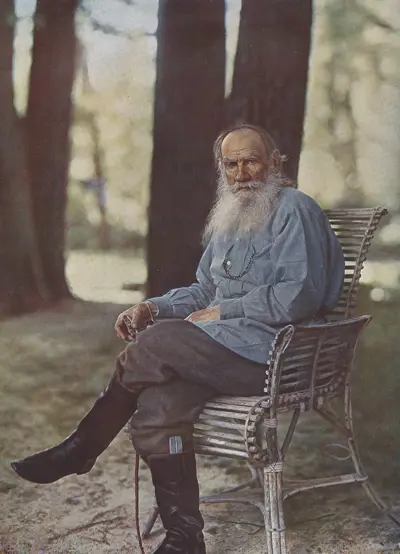
Count Lev Nikolayevich Tolstoy, 9 September, 1828 – 20 November, 1910), usually referred to in English as Leo Tolstoy, was a Russian writer who is regarded as one of the greatest authors of all time. He received nominations for the Nobel Prize in Literature every year from 1902 to 1906 and for the Nobel Peace Prize in 1901, 1902, and 1909. That he never won is a major controversy.
