John C. Calhoun Quotes
The most unquestionable right may be rendered doubtful, if once admitted to be a subject of controversy
This principle is used politically to try to control the agenda of a legislative body or in modern times the “agenda” of what is covered by the media. In Calhoun’s case, he argued for not even allowing the issue of slavery to be debated in Congress.
John C. Calhoun, 1782-1850, Vice President of the United States (Democrat, SC), U. S. Congressman & Senator (Democrat, SC), Senate Speech, February 6, 1837
Sourced by: Eigen's Political and Historical Quotations


Jefferson and some of the other Founding Fathers saw the American experiment as having implications for the whole world. To Jefferson, the Declaration of Independence was not just for Americans but ideally for all mankind.


He was considered Massachusetts’ greatest Colonial orator.


There is no declaration of rights … the declaration of rights in the separate states are no security
See Rufus King for the opposite position. {610244}


Hayward claimed that Wilson was the first American President who ever criticized the American Constitution. Many do not agree as Madison and Jefferson in part, along with most other Americans, found the Constitution so wanting that it was ratified only on condition of the passage of the Bill of Rights. Jackson, was distressed by the limitations on the President and many others had their objections, but Wilson, before he became a politician was a prominent academic political scientist and wrote voluminously and had an intellectual following so his criticism was not considered so “political” as others.

Agnes Gonxha Bojaxhui

This constitution, 13 years later, became the basis for the national Batavian Constitution.


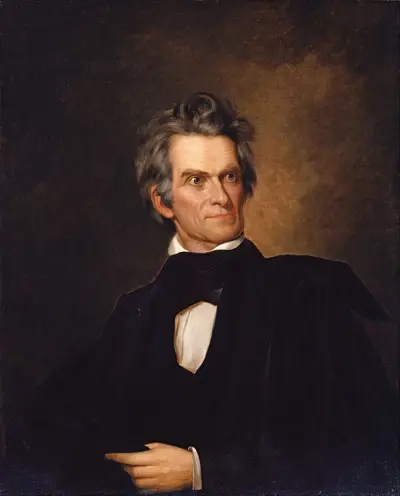
John Caldwell Calhoun was an American politician and political theorist from South Carolina who held many important positions including being the seventh vice president of the United States from 1825 to 1832, while adamantly defending slavery and protecting the interests of the white South when its residents were outnumbered by Northerners. He began his political career as a nationalist, modernizer, and proponent of a strong national government and protective tariffs. In the late 1820s, his views changed radically, and he became a leading proponent of states' rights, limited government, nullification, and opposition to high tariffs. He saw Northern acceptance of those policies as a condition of the South remaining in the Union. His beliefs and warnings heavily influenced the South's secession from the Union in 1860–1861.
