Friedrich Nietzsche Quotes
The moment Germany rises as a great power, France gains a new importance as a cultural power.
Nietzsche, Friedrich. Twilight of the Idols. Translated by R.J. Hollingdale, Penguin Books, 1968, p. 61.


This was a warning to Saudi Arabia that the United States might seize the oil fields. At the time we were not getting enough oil for domestic needs and the military in Europe and in Vietnam. The King arranged to secretly supply oil to the United States while maintaining to the other Arab countries that it was maintaining the boycott of the West.


At the time, the major European countries were in a competitive scramble for colonies in Africa—so much so that there were very few independent territories left. The maps and borders of Africa were really decided by the Europeans.

They were both children of Queen Victoria of England.


A few months later, that is exactly what Germany did. She was hoping that England would not enter the war despite her treaty obligations, but she was willing to risk the possibility. The Czar had a strong espionage and intelligence service active in Germany, but, like so many other intelligence failures, the intelligence operatives and analysts had military and economic facts but had little understanding of the German culture which propelled Germany to what to most other cultures was “irrational policy making.” People and nations often engage in irrational activities, even against their own self-interest.
The French were culturally not very warlike or militaristic and in the past two centuries had not been very aggressive like the British or the Germans. The Kaiser showed is ethnic ignorance in that the Anglo-Saxons were the merging of two people the English Saxons and the French who under William the Conqueror had defeated the Saxons. However, that was a common perception in racist Germany at the time. Most important however was that the Kaiser and the German military believed it and the fact that France may enter WWI against them was not taken as a serious threat so the German aggression proceeded. The French military gave Germany much more difficulty in the battlefield than they anticipated.


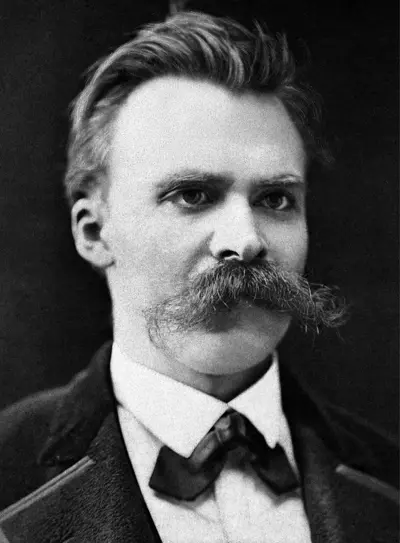
Friedrich Wilhelm Nietzsche was a German philosopher, cultural critic, composer, poet, writer, and philologist whose work has exerted a profound influence on modern intellectual history. He began his career as a classical philologist before turning to philosophy. He became the youngest person ever to hold the Chair of Classical Philology at the University of Basel in 1869 at the age of 24. Nietzsche resigned in 1879 due to health problems that plagued him most of his life; he completed much of his core writing in the following decade. In 1889, at age 44, he suffered a collapse and afterward a complete loss of his mental faculties. He lived his remaining years in the care of his mother until her death in 1897 and then with his sister Elisabeth Förster-Nietzsche. Nietzsche died in 1900.
