John Strachan Quotes
The Legislature of Lower Canada, consisting chiefly of Roman Catholics, could hardly be expected to support a church which they were taught to consider heretical, and in Upper Canada the scanty means at the disposal of the Government, precluded all hope.
Strachan, John. A Sermon, Preached at York, Upper Canada, Third of July, 1825, on the Death of the Late Lord Bishop of Quebec. John Carey, 1826.


It took only 10 days after the First Continental Congress met for religious bigotry to arise. After hundreds of years of Catholic/Protestant strife, each sect looked upon the other, not only as theologically wrong, but dangerous to the liberty of the other. Unfortunately, the organied religions had acted so badly towards other religions, that everyone was justified in fearing the other religions. This quotation illustrates a then typical attitude of many American Protestants that the Catholic Church was a threat to national security. Ironically, in modern times, anti-Catholic bigots use this quotation to demonstrate that the United States was founded as a Christian Protestant nation—not a general Christian nation. A small, vicious anti-Catholic sentiment still exists, usually by a minority of right wing Protestant religious fundamentalists. Protestant England had just repealed the laws making Catholicism illegal, but this was regarded at that time as intolerable for the new America. This was one of the disputes which that the Founding Fathers were faced with later and one of the reasons that they were so absolute in the need for the 1st Amendment.

This is a particularly interesting historical quotation because it succinctly gives a history of the various horrors of religious strife in British history—a history that was very well known to the American Founding Fathers and the general American Colonial population. This history was the major driver behind the public insistence for the Bill of Rights and the 1st Amendment which erected a wall of separation between church and state with government never favoring or abetting any particular religion.


Later, as President in 1811, Madison vetoed a bill granting Federal land to build a Baptist church in the Mississippi territory.


Kennedy was a Roman Catholic and there was a great deal of anti-Catholic prejudice in the country then. Al Smith, the only Catholic who had run for the Presidency, was defeated with almost all his opposition coming from anti-Catholic forces appealing to the then popular prejudice that if a Catholic became President, the Pope and the Vatican would be running America. Richard Nixon, a master politician with few scruples, cleverly kept raising the religious question in the voters minds by saying that he would not make Kennedy’s religion and issue of the campaign. Kennedy barely won.

1st Duke of Wellington. The prohibitions against Catholic participation dated from the time when the Pope and the Vatican tried to support Catholic insurrections in England to return it as a Catholic country which it had been until King Henry VIII had a dispute with the Pope. However, the Catholic attempt to take over England and crush the Protestant Church of England had occurred so long before that there was no practical danger to the then established Church of England. Wellington, an Irish Protestant himself, realized that the law presented no significant protection and caused not only great resentment of English and Irish Catholics, but denied the nation the benefit of their great talents in politics. England took a great step forward and passed the bill.


There has been a similar demographic condition since.

In this speech, and in {634756}, he argued against unification to a public that was mostly opposed. The leadership was interested because they were facing the Muslim Ottoman Turks who were getting more powerful each day. The Eastern Emperor, Constantine XI, more of a soldier and politician than a cleric, wanted the military strength of the Franks and other Western European Christian armies to help protect the Eastern Empire and Byzantium and were willing to reunite under the Pope to get it. Gennadios and his faction were not. They prevailed and the next year, the Muslims conquered Byzantium which had little help from the armies of the Western Roman Empire.
Many Protestant Englishmen were shocked to hear this, having little familiarity with the details of the functioning of the Church of England—the Established Church of Great Britain—in Ireland and the contribution of the Church to the discrimination against Irish Catholics and the poverty of Ireland.


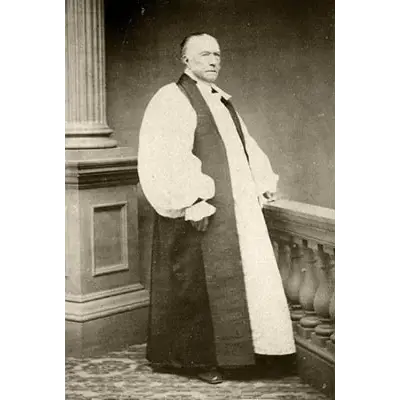
John Strachan was a notable figure in Upper Canada and the first Anglican Bishop of Toronto. He is best known as a political bishop who held many government positions and promoted education from common schools to helping to found the University of Toronto.
