George C. Marshall Quotes
The leader in a democracy has to keep the people entertained. That may sound like the wrong word, but it conveys the thought.
Churchill and the British Military wanted to start the offensive against Hitler by attacking and dislodging the Germans and Italians in North Africa and then attacking Italy before attacking France. The American military Generals wanted to attack France first and did not want an African campaign to divert from the main objective. However, France would take much longer to prepare for, and Americans were very anxious to have our forces go on the offensive. Roosevelt overruled the Generals and sided with Churchill also arguing that rolling up some victories in North Africa would be good for American morale and give us more time to produce more tanks, plans and other munitions which were then rolling off the assembly lines and an incredible clip. Churchill also advised that American troops were green and Africa would be good preparation. It turned out that this was the better course of action.
George C. Marshall, 1880-1959, General & U. S. Army Chief of Staff, U. S. Secretary of State, U. S. Secretary of Defense, Nobel Peace Prize Winner (The only soldier ever so honored), Quoted in Eric Larrabee, Commander in Chief
Sourced by: Eigen's Political and Historical Quotations

The only soldier ever so honored. At the beginning of WWII, President Roosevelt and Churchill wanted the U. S. Army to invade German and Italian North Africa. Marshall, General Eisenhower, and all the other military men, advised that while it was possible, it would be a diversion from the strategic objective of invading Europe. None the less FDR ordered the invasion. The effect on the American people was wonderful, It showed that the Germans were not invincible, increased enlistment and morale at home, and developed more popular support for the war. Later, Marshall learned much about Democratic leadership and he, himself became a very effective government leader, and began to appreciate FDR’s approach but with a little cynicism about democracy.


This was a new political phenomenon where a President was perceived as more important, more powerful, and preferable to his party. Note that the base of the scale is labeled “Public Opinion”.


His polls were low—55 percent disapproval and only 43 percent approval) at the time as a result of the poor management of the Obamacare rollout.


This is a wonderful historical picture of FDR on his campaign train. Note that the President liked to listen to ideas of many people. Unlike most Presidents he did not have any particular political programs that he advocated in his campaigning. He had no immediate answers to the Great Depression that he had inherited from the Hoover administration. But unlike Hoover, and most Presidents, he was willing to try ideas for which there was no advance evidence of success. If that did not help, he would try something else. He sought ideas from anyone and everyone. His enemies called him a weak leader who had no ideology—no principles but just trying unproven solutions to solve the nation’s critical problems. But it worked and he was elected 4 times—the only President who had served even 3 terms.


Compared to Most Democracies Canadian political power is shared between the Federal government and the provinces. As such the Prime Minister role in Canada is weaker than most heads of government.


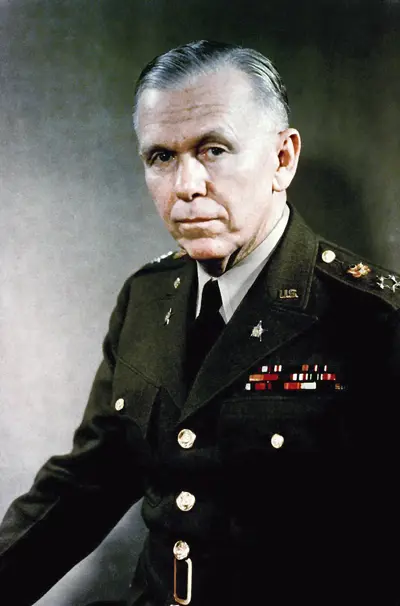
George Catlett Marshall Jr. was an American soldier and statesman. He rose through the United States Army to become Chief of Staff under presidents Franklin D. Roosevelt and Harry S. Truman, then served as Secretary of State and Secretary of Defense under Truman. Winston Churchill lauded Marshall as the "organizer of victory" for his leadership of the Allied victory in World War II. After the war, he spent a frustrating year trying and failing to avoid the impending civil war in China. As Secretary of State, Marshall advocated a U.S. economic and political commitment to post-war European recovery, including the Marshall Plan that bore his name. In recognition of this work, he was awarded the Nobel Peace Prize in 1953.
