Barack Obama Quotes
My polls have been up and down a lot. If I were interested in polling, I would not have run for President. I was polling at over 70 percent when I was in the U. S. Senate. I took this job to deliver for the American people.
His polls were low—55 percent disapproval and only 43 percent approval) at the time as a result of the poor management of the Obamacare rollout.
Barack Obama, 44th President of the United States (Democrat, IL), United States Senator (Democrat, IL), Press Conference, December 2013
Sourced by: Eigen's Political and Historical Quotations


Gore had lost the 2000 Presidential race to George W. Bush by Supreme Court controversial decision regarding the counting of the Florida ballots. Gore had won ½ million more votes. Most pundits assumed that Gore again would be a candidate and the press was already describing it as a potential sports championship rematch. Bush had a high approval rating but was most vulnerable regarding the economy and some other domestic issues. In the midst of the War on Terrorism and a potential Iraq war, Gore believed that the sporting rematch concept would detract from a public campaign that could focus only on issues—what he believed he and the Democratic Party needed to win.


Stimson had been a key member of the Theodore Roosevelt national administration, and Roosevelt, before he became Vice President and then President had been a very popular governor of NY. Stimson, although a brilliant administrator, and statesman was a bit stuffy and aloof and was a terrible campaigner. He thought it immodest to refer to himself in public or to talk about his record. See {589269}. So the Republicans tried to tie him to Roosevelt who was still very popular. See {589268}. It was not enough. Stimson lost.


This is a wonderful historical picture of FDR on his campaign train. Note that the President liked to listen to ideas of many people. Unlike most Presidents he did not have any particular political programs that he advocated in his campaigning. He had no immediate answers to the Great Depression that he had inherited from the Hoover administration. But unlike Hoover, and most Presidents, he was willing to try ideas for which there was no advance evidence of success. If that did not help, he would try something else. He sought ideas from anyone and everyone. His enemies called him a weak leader who had no ideology—no principles but just trying unproven solutions to solve the nation’s critical problems. But it worked and he was elected 4 times—the only President who had served even 3 terms.

Canes-Wrone developed Conditional Pandering Theory. The very popular Presidents do not have to engage in pandering. The unpopular presidents will not be helped much so they have little to gain by using this technique which is personally distasteful to almost all politicians. It is the middle of the road Presidents who tend to make the biggest use of policy pandering.


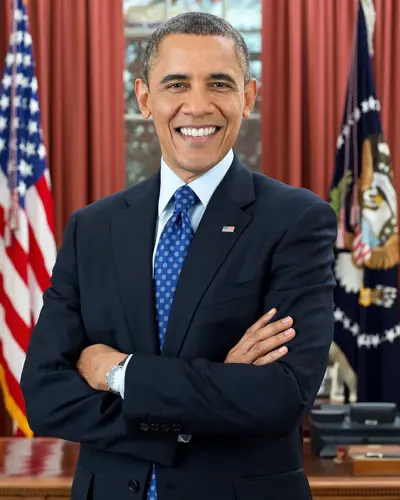
Barack Hussein Obama II is an American politician and attorney who served as the 44th president of the United States from 2009 to 2017. A member of the Democratic Party, Obama was the first African-American president of the United States. He previously served as a U.S. senator from Illinois from 2005 to 2008 and as an Illinois state senator from 1997 to 2004.
