Sun Yat-sen Quotes
The individual must not be allowed to be overly free, but the country must be entirely free. When the country can exercise freedom, China will have become a mighty and prosperous nation.
Sun, Yat-sen. San Min Chu I: The Three Principles of the People. Translated by Frank W. Price, Commercial Press, 1927, p. 213.


This has been one of the fundamental debates in America since its founding. Which is more important, the preservation of civil rights and personal liberty or the supremacy of the law and the stability of our institutions. In war, the tension is always existent. In law enforcement, there is also a common conflict. Prohibition, like the later War on Drugs, was not able to be enforced without the invasion of personal rights. Americans decided that Prohibition benefits were not worth it/ The debate is ongoing with respect to the War on Drugs.


‘Necessity’ is another word that governments use in such situations. To deal with “National Security” governments tend to extend their power over individuals, encroach upon civil rights” and repress their population. This is true of right and left wing governments, democracies and dictatorships.


The Bank was privately owned. Jackson was a major opponent of the Bank. See his description {630650} .


In a 1949 dissenting opinion in Terminiello v. Chicago Jackson claimed the majority view would “convert the Bill of Rights into a suicide pact.”

He was the Chairman of the Senate Judiciary Committee. The intelligence and law enforcement advocates of reducing privacy rights so that law enforcement can prevent acts of terrorism frame the question as a tradeoff between civil right and safety. However, as Leahy and many others point out, we would not be much safer if we gave up all our ivil rights. Further, hundreds of thousands of American have given their lives so that we would have those civil rights. Without them what are we protecting.

The Beltway refers to a ring highway around Washington DC. Almost all government offices are inside the Beltway and this is a euphemism for the Federal Government in Washington DC.

His political view was one of general opposition to Government—especially large Government. However, even the Conservative voters whose nomination he sought did not elect him to any public position. His inherited fortune allowed him to run for office and campaign.

This was another of the views of the fascists that drove much of their policies and practices but are demonstrably untrue. The world has many countries that have little power or world respect and yet the people are very happy. Luxemburg, Monaco, Finland and the Baltic Countries are just a few of the counter-examples.

L. P. Jacks

The King in his full dress military uniform had raced be carriage with his family to the Parliament building. The Germans had moved troops into Belgium and wanted that country to do nothing while they moved troops to attack France. The emotional question was answered with a shouted unanimous Oui! (Yes!). This meant that the small Belgian army would take on the huge and better equipped German Army and resist the invasion. They hoped for the assistance and intervention of England according to existing diplomatic agreements but they could not be sure. They did get the support of England and France, but later. In the meanwhile, the Germans used the Belgian defense of their land as an excuse for retribution and committing terrible war crimes and atrocities against Belgian military and civilian personnel.
Louis Napoleon Bonaparte. Louis Napoleon was running for the President of the new revolutionary government. Because he had been the nephew of Napoleon Bonaparte, he had been banned from France but returned after the 1848 revolution. His speech appears, in retrospect, ridiculous since within a year from his election, he would declare himself Emperor after engineering a coup and taking over the entire government.

This is a fundamental difference between fascistic and extreme conservative vis a vis democratic and liberal points of view. Thomas Jefferson was the greatest proponent of the right of individuals in a society to not only question the major civilizational choices that have been made but to possibly change them for each generation which is exactly what has happened in America and most liberal democracies. However, many argue the contrary that certain fundamental civilizational; choices are so fundamental that they are immutable and may not be changed. The alternative for those who do not care for those choices is to leave the country.

The "administrative state" was the term used for a government had had powers and used them to regulate things and areas of society without each specific regulation being voted upon by the legislature. In America sicne the New Deal there have been so many areas that have regulations that a single agency like the Environmental Protection Agency might issue in a year more regulations than the entire Congress considers in all areas put together. All these regulatory powers are delegated by Congress passing legislation authorizing it, and Congress can legislate any change in any regulation it wants, but the modern state is so complesx and areas so specialzied that Congress has preferred to delegate. There are a few who legal scholars and politicians who believe that it is unconstitutional for the legislature to delegate powers to the executive branch and no regulations have validity unless specifically passed by Comgress. There are some others who have not taken a position on this point but who believe that of an administrative state can regulate phases of citizens lives it is bound to circumscribe personal freedom as all legislation does to some extent. This quotation was used by opponents of Judge Gorsuch in arguing that he was unfit for the Supreme Court as he was out of touch with the Administrative State which America gradually became and rapidly in the New Deal and in the 80 years thereafter a very extensive administrative state. Gorsuch's views were based on classic political pholosophy but there were some ultra conservatives who did not want any regulation of business by Congress or Administrative Agencies and therefore supported Gorsuch and the few others with this view as if Agencies were not able to issue regulations there was no practical way that Congress could issue as many and regulation would be reduced which is what they desired.
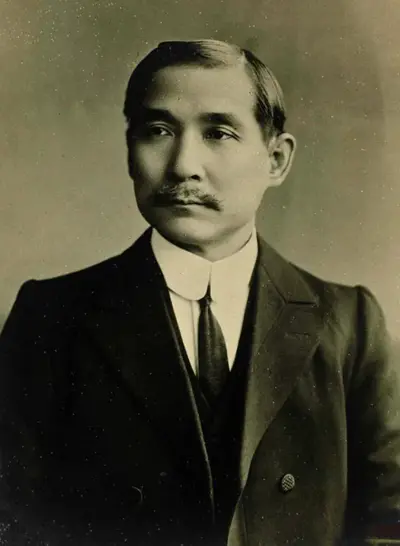
Sun Yat-sen was a Chinese statesman, physician, and political philosopher, who served as the provisional first president of the Republic of China and the first leader of the Kuomintang (Nationalist Party of China). He is referred as the "Father of the Nation" in the Republic of China, and as the "Forerunner of the Revolution" in the People's Republic of China for his instrumental role in the overthrow of the Qing dynasty during the Xinhai Revolution. Sun is unique among 20th-century Chinese leaders for being widely revered in both mainland China and Taiwan.
