Karl Rove Quotes
The increasing complexity of the Executive Branch is mirrored by the size of the cabinet.
Karl Rove, Presidential Assistant and Campaign Strategist (George W. Bush), Speech, University of Arkansas, Clinton School of Government, March 8, 2007
Sourced by: Eigen's Political and Historical Quotations


See {626594} for Polk’s negative view of delegation of any authority or responsibility.


The 534 he referred to were the Members of Congress.


On why the President should not be given the right to go to war without the approval of Congress:

The issue of how the federal judiciary would be selected was one of the more hotly debated issues during the Constitutional Convention.


This was the President’s original role regarding legislation. However, in the 20th century, Presidents have become more active and suggest laws and often initiate the process and then end it by signing the law that he suggested and shepherded through the Congress. But this was never the vision of the Founding Fathers, but since it is not addressed in the Constitution is not an unconstitutional process.

This letter was written shortly after the Constitution had been signed by the convention delegates. This difference between Adams and Jefferson would be at the heart of the first great partisan struggle in American history. Adams, as the second President, tried to increase and use the power of the Presidency. Jefferson opposed him, especially when Adams tried to run for a second term. The Adams-led Federalists were pitted against Jefferson’s Democratic Republicans in the first, and perhaps still the most bitter partisan struggle in American political history. The Jeffersonians accused Adams and the Federalists of trying to unravel the American Revolution and revert to a monarchy. The people not only sided with the Democratic Republicans, ousting Adams, but also turned out most of the Federalists. It was the end of the Federalist Party, and a new conservative party—without monarchial tendencies—the Whigs became the new opposition party.
Hamilton thought that the Executive Branch should be co-equal with the Judicial Branch and lifetime tenure should apply to both. This quotation is very important as we consider developing countries and emerging democracies. Some in the third world have Presidents for Life—a concept that most democracies scoff at. But the stability and the independence was important enough to some of the Founding Fathers was actually advocated and considered as we formed the American Democracy.


The President’s and the Parliament’s actions are all subject to the veto of the Guardian Council and the Supreme Leader—self perpetuating Islamic clerics. This is the statement that explained their action of disqualifying over 1000 candidates for Parliament and the Presidency leaving only 6 who were acceptable. Then the people have a right to vote from among the 6 and can be assured that their President will not have an original thought or have any views different from the Supreme Leader, Ayatollah Sayyid Ali Khamenei.


Note that early constitutional experts assumed that one of the President’s roles was to be non partisan and control partisanship. Note the phrase ‘prevent the artifices of party’. The early founders were very wary of political parties of ‘factions’ as Madison called them. However, most were extremely partisan although in the Presidency partisanship was toned down by George Washington but after him, partisan ship became the norm.
The Mexican War was as controversial as any war in American History. President Polk ordered action independent of the Congress, In all of American History there have been two Congressional censures of American Presidents. This was one. See {594521} for the other.

Alberto Gonzalez, White House Counsel and later Attorney General who was forced to resign and David S. Addington, Counsel to the Vice President, had come up with a novel view of the powers of the presidency. They argued that since the President is the Commander in Chief, in a war situation or intelligence gathering thereto, has the Constitutional responsibility for that function, he need not obey any laws of Congress as in the conduct of the war Congress would be impinging on the Constitutional separation of powers which itself was prohibited by the Constitution. The argument did not find any significant legal support but for a while the George W. Bush White House behaved as if this were the law, despite the fact that even in the American Revolution and the War of 1812 Congress passed laws regulating the conduct of the armed forces as is provided for in other parts of the Constitution. Yet even Goldsmith would allow the President some powers that many think are unconstitutional and/or belong to Congress. See {32436}.


Some people get upset when they learn that members of the President’s cabinet disagreed with the president on a major policy. Yet this is very common and very desirable as long as when the President reaches his/her decision, the dissenters all close ranks and implement it. Some Presidents are not secure enough or confident enough to be comfortable with dissent. The greatest of our Presidents were known for their selection of strong advisors who have different perspectives. President Lincoln had all his rivals for the Presidency in his cabinet. Franklin Roosevelt appointed a number of Republicans to his cabinet and a left wing socialist also. Theodore Roosevelt’s Secretary of State, Elihu Root, was famous for telling the President where Root thought he was wrong. George Washington had Thomas Jefferson and Alexander Hamilton in his cabinet and they fought like cats and dogs. Jefferson ran against Washington’s Federalist party and destroyed that party at the polls. However, the nation was better for these brilliant, experienced cabinet members helping a strong President to make consider all possibilities and make better decisions.
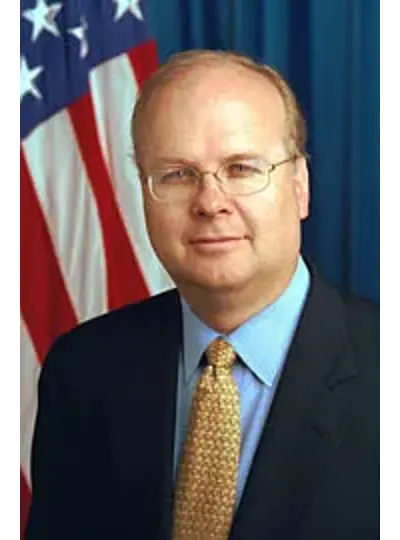
Karl Christian Rove is an American Republican political consultant, policy advisor and lobbyist. He was Senior Advisor and Deputy Chief of Staff during the George W. Bush administration until his resignation on August 31, 2007. He has also headed the Office of Political Affairs, the Office of Public Liaison, and the White House Office of Strategic Initiatives.
