Edward Carrington Quotes
The importance of this event (the Philadelphia Constitutional Convention) is every day growing in the public mind, and it will, in all probability, produce an happy era in our political existence…. Public events in the United States since the peace have given a cast to the American character, which is by no means its true countenance. Delinquencies of the States in their federal obligations; acts of their legislatures violating public Treaties and private Contracts, and an universal imbecility in the public administrations, it is true, form the great features of our political conduct; but these have resulted rather from constitutional defects, and accidental causes than the natural dispositions of the people.
The Articles of Confederation had no Federal teeth and the Continental Congress and the State Government’s were a mess after the Revolution. At the time of this writing to Jefferson in Europe, the Philadelphia Constitutional Convention had begun and many were pinning all their hopes on the outcome. While the proceedings of the convention were secret, the fact that it was ongoing was not only public knowledge, but there was intense public interest and hope for its outcome. The delegates were under a great deal of public pressure to unify the nation and come up with a viable form of government.
Edward Carrington, 1748–1810, Mayor of Richmond, Virginia, Virginia Member of the Continental Congress, Quartermaster General of the Revolutionary Army, Letter to Thomas Jefferson, June 9, 1787
Sourced by: Eigen's Political and Historical Quotations

In every American war, there have been those leaders who wanted to fight it “on the cheap.” While most modern people are most aware of the George W. Bush Administration providing insufficient funds to our troops in the Iraq War, there was a problem in the First World War, and President Roosevelt had to twist conservative arms to get the funds necessary for the Second World War. But even the American Revolution had the same problem as this quotation illustrates.

Even after the American Revolution, the Government of the Continental Congress under the Articles of Confederation was a mess which would only be resolved by the Constitutional Convention the next year and the ratification of the Constitution.


Samuel Langhorne Clemens, 1835-1910


The Constitution was not drafted until 1787 and was ratified later. In the interim the young United States functioned under the Articles of Confederation, in a sense, our first Constitution. This clause established that the Federal Government should have the exclusive power and authority to conduct foreign affairs.

He was expelled from Parliament for such.


At the time, the Tea Party wing of the Republican Party had refused to compromise on anything and many saw as their primary objective was to make sure that the Democratic President was not successful with any of his legislative program. There was gridlock and divided government had become paralyzed government. Buffet and most other Americans were fed up with the gridlock and wanted Congress to start compromising and solving problems.


On that day, the Republican Majority in the House adopted a strategy to attach conditions to the normal budget process that they knew was unacceptable to the Senate and the President. The United States Government, the greatest nation on Earth, literally shut down all but the most essential services. What was worse is that the majority of the House of Representatives would pass a clean budget if they could vote on it. But the Tea Party Republicans blackmailed the Republican speaker that he would lose his speakership if he did not follow their strategy which was ironically controlled by a Republican Senator who had already lost on the issues they wanted in the Senate and in a Presidential election.

The objective of a large proportion of the Congress then was not to improve the nation or even pass legislation, but to preserve their ideology and attack and weaken the other party. Compromise for example is probably the best legislative practice, but that Congress had a substantial number of Tea Party and other ultra conservatives who believed that any compromise at all was an immoral abandonment of principle.

While this is a common complaint in the American political dialogue at the beginning of the 21st century, it is interesting that this was the conclusion of a foreign political scholar studying that period—one who was generally a great admirer of America.


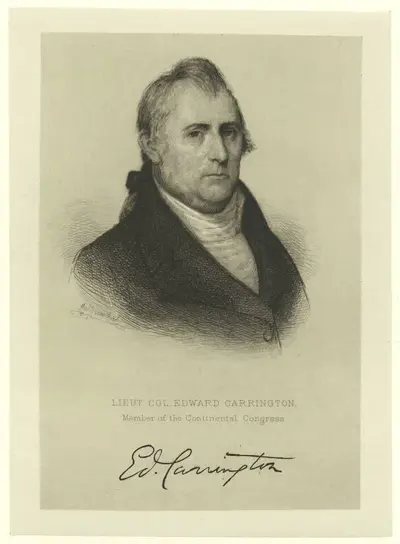
Edward Carrington was an American soldier and statesman from Virginia. During the American Revolutionary War he became a lieutenant colonel of artillery in the Continental Army. He distinguished himself as quartermaster general in General Nathanael Greene’s southern campaign. He commanded artillery at Monmouth and Yorktown. He was also present at Cowpens, Guilford Court House, and Hobkirk's Hill. During the war he became a close friend of George Washington. Carrington served in the 3rd Continental Congress and was the first US Marshal appointed from his state. He was an original member of the Society of the Cincinnati.
