Thurgood Marshall Quotes
The government they devised was defective from the start.
Referring to the fact that the framers of the constitution did not deal with slavery or womens' suffrage:
Thurgood Marshall, 1909-1993, U. S. Supreme Court Justice, Quoted in Newsweek, May 18, 1987
Sourced by: Eigen's Political and Historical Quotations

Anti-slavery opponents had cited the equality argument of the Declaration of Independence to buttress their argument.

Bickel was then clerk to Justice Frankfurter.

Benton's solution was for the people to elect the President and Vice President directly.


Dix finally broke with the Democrats over the slavery question and became a Republican.


Most of the delegates to the Constitutional Convention were aristocrats, and all were elites of different types. However, they wanted and knew that they would have to submit their work product to the people for ratification. So while each had their own views, most were heavily influenced by their perception of public opinion reaction to their draft. Even with that, in order to get the ratification votes, they had to add the first 10 amendments—the Bill of Rights in order to get the votes of the men who were NOT at the convention.
Many of the delegates to the Constitutional Convention of 1787 had invested in land that had formerly belonged to the Iroquois Indians who had sided with the British in the Revolution and been driven up to Canada. They had paid very little and wanted to sell it at large profits. However, there was little gold and silver left in the colonies after the war and there was great reluctance in the rest of the world to lend gold and silver backed money to a new country that did not have a rule of law and courts to collect debts. For example, Madison and Monroe had formed a partnership and bought former Iroquois land near Rome, New York. There was idealism to be sure but there was also self-interest functioning in the secret Constitutional Convention.


Jefferson’s original was: We hold these truths to be sacred and undeniable that all …
He had been asked by other delegates what Franklin thought they had just created.
Franklin wrote the speech, but was too old and ill to deliver it personally. James Wilson of Pennsylvania did the honors for him.
Behind George Washington's presidential chair there was artwork that included a sun.

In the first part of the 18th Century, one county in Virginia became a magnet for runaway indentured servants, The more runaways settled there the more empathetic and hospitable they were to new runaway servants. The culture at the time had identified knowing your place in society and accepting it. So a runaway indentured servant had renounced their oath and contrast to serve their masters, and hence were not Christians. These renegades were armed and there was not enough political will or support for forcing the County to comply with the laws and mores of the time.
He was referring to slavery, poverty and degradation for most of the whites.

Wilson was using logic and consistency to show the absurdity of the proposal to count three fifths of the slaves as people for the apportionment of congressional seats. Particularly difficult for the Southern States to refute was his point that who should other property not be considered in addition to slaves in the apportionment formula? Factories, farms, land value, raw materials, merchandise, etc. That compromise however prevailed regardless of its inconsistency and failure to adhere to any principles. This was the only way to have the South join the new nation.

This moral statement from a New jersey Quaker abolitionist is not particularly noteworthy, However what makes this quote important is that Woolman traveled throughout the South preaching this as his main theme. At that time — before the American Revolution — he did so and was not attacked or intimidated; he was mostly ignored by the Southern authorities. At the time, the South was very confident of its ability to continue slavery. Years later, when the abolition movement grew larger and stronger, a Northern Quaker Preacher doing this not not escape with his life.
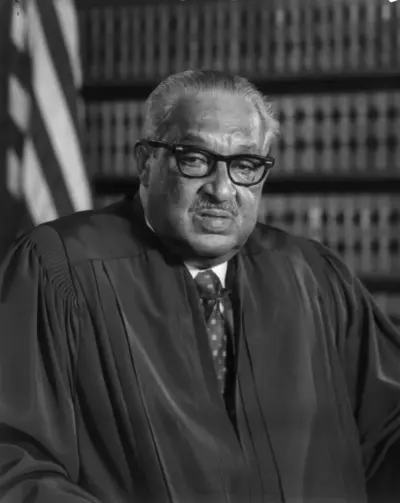
Thurgood Marshall was an American lawyer and civil rights activist who served as Associate Justice of the Supreme Court of the United States from October 1967 until October 1991. Marshall was the Court's first African-American justice. Prior to his judicial service, he successfully argued several cases before the Supreme Court, including Brown v. Board of Education.
