Ekkehard of Aura Quotes
The Germans at first regard the crusaders as madmen … Consequently the many legions of horsemen who passed through their land [largely French], the hosts of people on foot, the crowds of country people, women and children, were viewed by them with contempt as persons who had altogether lost their wits.
Ekkehard of Aura. 1050-~1125, German Benedictine monk & Historian, On the Crusades
Sourced by: Eigen's Political and Historical Quotations

Christians of 1 thousand years ago were barbarous and immoral compared to Christians of today, even though their Bible is the same. He argued that Islam may well also reform. In looking at Islam compared with Judaism, Christianity, Hinduism and Buddhism, it is useful to remember that these are much older religions than Islam. They have had more time to reform and develop. Compare Christians 700 years ago to Christians today. They were pretty barbaric in comparison. They burned heretics at the stake and "witches" also. But Islam is 700 years younger than Christianity and thousands of years younger than the other 3 religions mentioned. It may well need more time to develop and reform.


In addition to the Muslim world during the Crusades losing control of the Holy City for the first time in 400 years, the Christians stabled their horses on the Al Axa Mosque and the Dome of the Rock, two of Islam’s holiest places. In addition, the Crusaders, after taking the city, slaughtered most of the inhabitants—Muslims, Jews and even fellow Christians who were Eastern Orthodox—more than 30,000 in just a day or so. It was a reign of terror on a scale that even today, it is shocking to most. So where as to us the Crusades were an interesting of aberrant part of history, to many Muslims of the Middle East the thought or discussion of the Crusades is traumatic even today.

King Constantine I of Greece Saint Sophia is the name of the Great Church in Istanbul (Constantinople) built by the Christians in 537. For Christians it was synonymous with the City of Istanbul which had been captured by the Muslims in 1453 and has been the capitol of Turkey and the Ottoman Empire ever since. A “dream” of some Christians has always been to recapture Constantinople, and this is what the King played upon despite the total, practical impossibility at the time.


The Christian Crusaders had captured Jerusalem and slaughtered the Muslim civilian inhabitants. In the 21st century, some Islamic terrorists justified the beheading of captured Christian prisoners as revenge for this massive Christian beheading of Muslims almost 1,000 years earlier.


The Germans allied themselves with the Islamic insurgency of the day as a strategic maneuver. The Grand Mufti of Jerusalem broadcast propaganda from Nazi radio in Berlin and was dispatched to organize Muslim fighters in Iraq. Fascism was introduced into the Middle East and the Arabs and Persians saw it as a natural extension of their authoritarian and highly prescriptive forms of religious and civil government. 60 years later, there would be Islamic Fascists throughout the Middle East in control or vying for control of many of the countries.

The German government had actually secretly bought the newspaper and it was controlled by Wangenheim, their Ambassador to Turkey. German strategy was to inflame the Muslim world into a jihad against the allies in WWI. See {51556}.
When the Turks defeated the Christians, the only explanation many Christians could conceive of was that God was on the side of the Turks.

The French army had crossed the border invading Tunisia. The Bey appealed to the English and others who had signed the Treaty of Berlin guaranteeing the independence of Tunisia. However, the Bey did not realize that the English and the French had already made a deal whereby France would invade Tunisia and England would take Cypress.

See {611922} and {611923}. The Sultan proved prophetic. His troops soundly defeated the French and then beheaded tens of thousands of French prisoners. The King was captured and ransomed. The Sultan however, despite his victory, was overthrown and killed.

The source was in the form of an autobiography but was written later by someone unknown. Prior to WWII and the German killing of over 25 million people, Tamerlane was responsible for more killings than any other ruler in the world. 17 million is generally given as the number if one analyses the Persian, Indian and other literature. He controlled the Middle East, the Ottoman States, a part of Russia and Eastern Europe, Persia and much of China and India. Although he himself was a Muslim he warred against other Muslim states and warlords defeating them all. Muslim nations are historically very ambivalent about Tamerlane. Pride as a conqueror is eclipsed by this excessive rapine and murder. In one case, the Persian city of Isfahan, he actually built a giant pyramid of 70,000 decapitated heads of prisoners. Also, the fact that he attacked and defeated major Muslim empires violates a current Muslim notion that there is a unity of Islam. He attacked, conquered and butchered the Ottomans, Syria, Iraq, Persia and the Muslim (Mugal) states of India.

The Teutons were the Germanic tribes who were very warlike. His prediction of German war and aggression was demonstrated by WWI and WWII. The French Revolution diminished the influence of religion throughout Europe.
The juxtaposition of scenes of murder and brutality together with God and holy purposes seems foreign to us today. It is extant among some Islamic groups who exult in similar scenes while calling to God. This “barbarity” is historically not just Islamic but was typical of Christians as well. Beheading was common in the Crusades, and it is still popular among some of the Islamic extremists who look to the “old days” as a model for them today.

This particular quotation is very important. Khomeini was probably the most influential Muslim in the 20th Century. The fact that he wrote this in 1942—before there was an Israel as an enemy—shows how deep seated the requirement for world conquest is. To the Nazi’s world conquest was a justifiable goal. To Khomeini and his many followers, it is a religious obligation and duty and thus is every more dangerous. Extreme anti Muslims justify the attempted expulsion of Muslim immigrants on the grounds that they are a fifth column whose loyalty is and will be to the religion which will attempt to conquer their country. It gives Islamaphobia a veneer of respectability.


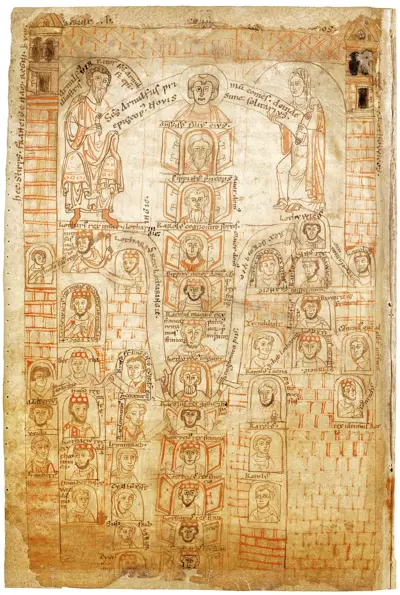
Ekkehard of Aura (Latin: Ekkehardus Uraugiensis; died 1126) was the Abbot of Aura (a monastery founded by Otto, Bishop of Bamberg, on the Franconian Saale river, near Bad Kissingen, Bavaria) from 1108. A Benedictine monk and chronicler, he made updates to the World Chronicle (Chronicon universale) of Frutolf of Michelsberg adding important German history between 1098 and 1125 during the reign of Emperor Henry V, in which he sided strongly with the papacy in the Investiture Controversy. He was a participant in the Crusade of 1101 (Lerner, 1989), and provided important source material for the Rhineland massacres of Jews and for the First Crusade.
