Heinrich Heine Quotes
Christianity may have restrained the martial ardor of the Teutons for a time, but it did not destroy it; now that the restraining talisman, the cross, has rotted away, the old frenzied madness will break out again.
The Teutons were the Germanic tribes who were very warlike. His prediction of German war and aggression was demonstrated by WWI and WWII. The French Revolution diminished the influence of religion throughout Europe.
Heinrich Heine, 1797-1856, German Writer & Critic, Quoted by Adam Zamoyski in Holy Madness: Romantics, Patriots, and Revolutionaries, 1776-1781
Sourced by: Eigen's Political and Historical Quotations


The Hun were a very fierce, Asian people who under Attila, defeated the troops of the Roman Empire and sacked several Italian cities. They fought very intensely and terrorized their enemies. The Kaiser came under great criticism from other European powers from urging his soldiers to emulate vicious barbarians with no sense of Christian morality.


The contrast between the Christian piety memorializing the taking of the city and then as soon as the ceremonies were complete the pillaging and plundering, is dramatic. Religion controlled and permeated the military thoroughly at the time—even to the organization of un-Christian acts like plunder and murder of civilians.


The Papacy was at one of it’s lowest points. Two men, Clement and Urban, both claimed the Papacy and each had raised an army to fight the other. Each was promising indulgences to those who would fight, and in a modality similar to the Muslim terrorists of the 21st century, the soldiers were promised ascendancy to Heaven if they fell in battle for such a holy cause. The armies of the popes marched under the cross as their banner, and Wycliffe found that obscene and actually wrote a treatise saying so. See {618087}.


Honore Gabriel Victor Requiti

The two were cousins. Wilhelm was a very dominant personality and his cousin quite weak. This quotation shows the tyrannical view of the German Kaiser. The letters were secret but after the execution of the Czar, the Russians released the letters to show the dominant and warlike history of Germany under the Kaiser who was furious that the Russians had made such personal and secret letters public. Russia was in conflict with Japan in what would be called the Russo-Japanese War. The racist views of the German aristocracy was shared with respect to Asians in remembrance of the Mongol invasions of Russia.

The Sultan responded (See {612151}) The King should have worried. The Sultan’s troops soundly defeated the French and then beheaded tens of thousands of French prisoners. The King was captured and ransomed.
The Sultan responded (see related quote): The King should have worried. The Sultan’s troops soundly defeated the French and then beheaded tens of thousands of French prisoners. The King was captured and ransomed.

In 1453 the Ottoman Turks shocked Christendom by capturing Constantinople, the capital of the Byzantine Eastern Christian Empire. It was always perceived as a religious conflict between Christians and Muslims but that is an over simplification of a very complex sociological, religious, and political historical period. As this quotation shows us there were many Christians aiding the Muslim side. There were also many Muslims fighting on the Christian side.
Shahin’s empire which he conquered for Khosrow II comprised all of the Middle East into parts of India. The Byzantine Roman Empire controlled everything from Constantinople to the West. They were the two “superpowers” of the day. Shahin was attacking various Byzantine holdings outside of the city of Constantinople. Even before Islam, religion was a major conflict between East and West.
King Constantine I of Greece Saint Sophia is the name of the Great Church in Istanbul (Constantinople) built by the Christians in 537. For Christians it was synonymous with the City of Istanbul which had been captured by the Muslims in 1453 and has been the capitol of Turkey and the Ottoman Empire ever since. A “dream” of some Christians has always been to recapture Constantinople, and this is what the King played upon despite the total, practical impossibility at the time.
This was not the ravings of a right wing extremist. It was normative for Prussia as a whole. Right wing extremism as we think of it today was the norm of the ruling classes in Prussia and other parts of Germany. This book was a best seller in Germany. This quotation illustrates the mentality of the conservative, militarist, culture that dominated Germany at the time. The German aggression of WWI was not even considered as immoral but a God-given right.
The Hapsburgs were the ruling family of the Austrian Empire who wanted to invade Serbia in retaliation for their complicity in the assassination of the Austrian Archduke. This would likely bring Russia in the war in support of Serbia. The editor thought that there was no obligation to support Austria when they were planning a war of choice. What the editor did not know was that the German leadership very much wanted war at the time and supporting Austria was the perfect excuse to fight without them starting the conflict. However, the evidence became clear later than it was German aggression that turned the dispute into a World War.

The Times regretted that the Germans did not speak to the Austrians more vigorously when they were threatening to attack Serbia who harbored anti-Austro-Hungarian terrorists (see {642085}). What the Times editors did not realize was that the Germans had already made their war plans (see {642092}) and the Serbian issue was just the justification they needed to implement them. So there was no real reason for the Germans to discourage the Austro-Hungarian Empire from its mission to punish Serbia.


He always appeared in a military uniform after that.


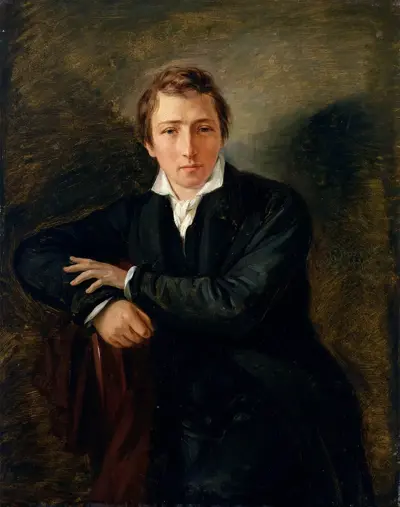
Christian Johann Heinrich Heine was a German poet, writer and literary critic. He is best known outside Germany for his early lyric poetry, which was set to music in the form of lieder (art songs) by composers such as Robert Schumann and Franz Schubert. Heine's later verse and prose are distinguished by their satirical wit and irony. He is considered part of the Young Germany movement. His radical political views led to many of his works being banned by German authorities—which, however, only added to his fame. He spent the last 25 years of his life as an expatriate in Paris.
