Noam Chomsky Quotes
When General Allenby conquered Jerusalem during World War I, he was hailed in the American press as Richard the Lion-Hearted, who had at last won the Crusades and driven the pagans out of the Holy Land.
Chomsky, Noam. Understanding Power: The Indispensable Chomsky. The New Press, 2002, p. 116.

See {582893} for Saladin's Reply. King Richard was the leader of all the Christian forces in the Holy Land for the Crusade. There was a belief, that a wooden cross in the possession of the Muslim force was the true cross of the Crucifixion of Jesus Christ

In addition to the Muslim world during the Crusades losing control of the Holy City for the first time in 400 years, the Christians stabled their horses on the Al Axa Mosque and the Dome of the Rock, two of Islam’s holiest places. In addition, the Crusaders, after taking the city, slaughtered most of the inhabitants—Muslims, Jews and even fellow Christians who were Eastern Orthodox—more than 30,000 in just a day or so. It was a reign of terror on a scale that even today, it is shocking to most. So where as to us the Crusades were an interesting of aberrant part of history, to many Muslims of the Middle East the thought or discussion of the Crusades is traumatic even today.
When the Turks defeated the Christians, the only explanation many Christians could conceive of was that God was on the side of the Turks.


King Richard was the leader of all the Christian forces in the Holy Land for the Crusade. See related quote for King Richard's initial peace proposal message.
The treaty was for the surrender of the city of Acre. King Richard led all the Christian Crusaders. He has always had a good reputation in the West, and most people—especially the English would be surprised to learn that in order to speed up compliance with a treaty he ordered this atrocity. Christian historians corroborate the slaughter.
Christians of 1 thousand years ago were barbarous and immoral compared to Christians of today, even though their Bible is the same. He argued that Islam may well also reform. In looking at Islam compared with Judaism, Christianity, Hinduism and Buddhism, it is useful to remember that these are much older religions than Islam. They have had more time to reform and develop. Compare Christians 700 years ago to Christians today. They were pretty barbaric in comparison. They burned heretics at the stake and "witches" also. But Islam is 700 years younger than Christianity and thousands of years younger than the other 3 religions mentioned. It may well need more time to develop and reform.


A large part of the Middle East and the now “Arab” states used to be a very large Jewish State. Jews had lived in the Palestinian area and expanded from there, also using conquest as all other nations had and even occasionally, forced conversion, to establish the Jewish State. This was destroyed by the Romans and the Jews have not had a state until 1948 when the UN voted to create Israel.
At the time of the writing she was an ex-queen. See {618099} for Frederick’s own view of the Greeks. The Crusades were going badly for the Christians at this point. The Greek Emperor had, after promising to be a part of the Christian alliance, made a separate treaty with Saladin and the Muslims, making him an outcast and sewing the seeds of the schism between the Eastern and Western Christian Churches. In a year, the Western Christians would sack Constantinople, and murder and plunder their fellow Eastern Christians. The two previous Greek Emperors were suspect from the Western point of view, but the treaty with Saladin “proved” what had been suspected about the Greeks who were now allied with the hated Muslims.

The Temple Mount in Jerusalem is the base on which the Great Jewish Temple was erected. The temple was destroyed by the Romans. Hundreds of years later the Muslims built a mosque which the Prophet Muhammud himself is believed to have transported to. One side of the Temple Mount is the Wailing Wall, the holiest place on Earth for Orthodox Jews. When the Arabs controlled Jerusalem, they would not allow any Jews to pray at the Wailing Wall. When the Israelis gained control of the holy city they were more reasonable. They ceded day to day control of the Temple Mount—the top and the Mosque—to the Muslims and since then Jews have prayed at the side of the Mount and Muslims on the top. However there has been some friction about the archeology of the interior of the Mount itself. And some Muslims resent the fact that Israel controls the security and access to one of their holiest Mosques, and that in the event of some transgression in the Mount, Israeli civil law controls and not Islamic religious law—Sharia. Some permanent agreement will have to be made if there is to be an overall peace.


Ottoman Turkish Sultan Mehmed II Aeneas Sylvius Piccolomini. 6 years earlier, the Ottoman Turks, had captured Byzantium (Constantinople, later Istanbul), the capital of the Eastern Roman Empire. The Pope had called together the rulers and leaders of Christendom to organize a common defense in this war of civilizations. This was the period where Christian Islamophobia began. The Muslims had a religious duty to convert the rest of the world to Islam and adopt Islamic law (Sharia). However, so did the Christians. Sultan Mehmed II, when he conquered Byzantium, did not require the conversion of the Christians in the great city. He took the greatest churches, but by and large left the Christians to worship in their own Churches. The Muslims at the time were far more tolerant of Christians (and Jews) than the Christians were of Muslims (and Jews). Like in the 21st century, there was much Islamic doctrine and reality to be worried about, but not all the Muslims were as rabid and extreme as Eastern paranoia suggested in the 15th century or the 21st.

Greece had always coveted Anatolia which was a part of the Ottoman Empire but had been in antiquity a Greek dominated area. Further, people of Greek ethnicity and culture, who hundreds of years ago use to be the vast majority were after the hundreds of years of Ottoman rule and migration were then the largest minority in Anatolia. After the Turks lost the First World War as a consequence of their allying with Germany, and had been stripped of its Arab territories. Also, Turkey had just undergone a revolution and the old order was displaced. Venizelos saw this as an opportunity to get back Anatolia and sent a military invasion force to land at Smyrna (Ismir to the Turks), the largest city of Anatolia where despite the Greek minority in all of Anatolia, Greeks were a small majority in Smyrna. Greece was accused of making war on the Muslim Ottoman Turks. This was his answer to the British press. The invasion was initially successful but was then repulsed by the Turk revolutionists lead by their great patriot Ataturk who defeated the Greek forces handily despite the fact that they were hastily organized, untrained together, and much more poorly equipped than the Greeks. Turkey was very corrupt until the Ataturk reforms, but Greece was arguably even moreso.

1914 was the outbreak of WWI in which all the belligerents had very different interests and reasons for war—even allies on the same side greatly differed as to their motivation for fighting.

1st Viscount Grey of Fallodon. The first published version of this prescient quotation appeared.

He is a Greek Orthodox Christian, and he correctly observes that the Islamic world was considerably more tolerant than the Christian until the 18th century when Islam had become less tolerant in the Middle East while the Christians were modernizing and going through a cultural and intellectual enlightenment and societal modernization while the Muslims, became less tolerant than they were in earlier years leading to the modern situation.
After King Henry VIII left the Roman Catholic Church and adopted Protestantism, English Protestants were in great danger in Catholic Europe. Queen Elisabeth I, with its traditional trading partners in Catholic Europe too dangerous for English merchants, negotiated successfully with the Ottoman Empire Sultan Murad III, for mutual trading. An Englishman was much safer in the Islamic world than he was in Europe. Not only did England open up new markets but its merchants developed the skills of trading with the East which was one of the main factors allowing them to be so successful in establishing the British Empire which was always fundamentally a trading empire. Elizabeth’s successful foreign policy not only allowed prosperity despite the schism with Europe, but established the foundation for England to become the greatest world power.


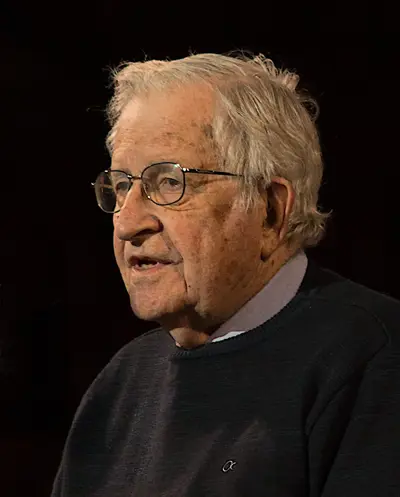
Avram Noam Chomsky is an American linguist, philosopher, cognitive scientist, historian, social critic, and political activist. Sometimes called "the father of modern linguistics", Chomsky is also a major figure in analytic philosophy and one of the founders of the field of cognitive science. He is Laureate Professor of Linguistics at the University of Arizona and Institute Professor Emeritus at the Massachusetts Institute of Technology (MIT), and is the author of more than 150 books on topics such as linguistics, war, politics, and mass media. Ideologically, he aligns with anarcho-syndicalism and libertarian socialism.
