Edward R. Murrow Quotes
The first colored man to enter outer space will, in the eyes of the world, be the first man to have done so. I see no reason why our efforts in outer space should reflect with such fidelity the discrimination that exists on this minor planet.
Edward R. Murrow, 1908-1965, Journalist, Director, United States Information Agency, Memorandum to John F. Kennedy, April 23, 1962
Sourced by: Eigen's Political and Historical Quotations


Many fighters for civil rights split from the majority of the Black leadership over racial preferences for affirmative action.

There was extensive Northern opposition to the idea of Blacks fighting in the Civil War, even from some abolitionists who saw the war as a vehicle to end slavery. A few were concerned that Blacks would be executed by the South if they were captured, and hence would be exposed to unreasonable risk. Others, believed there was sufficient manpower and Blacks fighting would make the South fight harder. Many didn’t believe that Blacks were competent to be soldiers, and others didn’t want Blacks to develop the skills that would later enable them to compete for jobs with whites. Before Albion raising the 54th there were a few Negroes who were in Union uniform, but the concept of a Negro regiment was a much more visible, and controversial concept.


He would not allow himself to be buried in a cemetery that would not allow Blacks. He was laid to rest in Shreiner's Cemetery, one of the very few racially integrated cemeteries at the time.


Humphrey was the Mayor of Minneapolis then.

He was the only Black member of Congress at the time.

This was a very courageous speech for the President to give. Senator Hubert Humphrey had proposed civil rights legislation. At the time most of the racial conservative members of Congress were Democrats and not Republicans as they would become after Civil Rights legislation actually passed in 1964. There was little possibility that the civil rights law would pass as the Southern Democrats could filibuster it in the Senate. None the less Truman supported the legislation and the principle of equal rights despite the fact that he was a Southerner and he knew he would lose the support of the conservative wing of his party.

Qutb was studying at Greeley College and with some Egyptian friends want to a movie theater. Greeley, even though not in the South, practiced racial discrimination in many of their public accommodations and the Civil Rights Law would not be passed for another 15 years or so. The ticked clerk at first would not sell tickets to the dark skinned Egyptians and when one protested, the owner was called. He ruled that as long as they were not American Blacks, they could enter. But Qutb refused.


The Secretary of State told the President he was resigning to save the administration possible embarrassment over his daughter's planned marriage to a black man:

Moynihan was actually not the political originator of the "benign neglect" phrase which became so controversial. It had been first used by The Earl of Durham in his 1839 Durham Report on the English policy towards Canada.
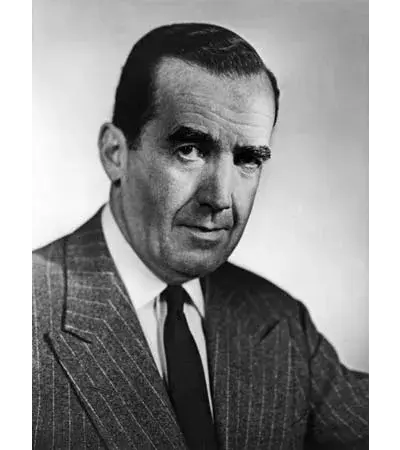
Edward Roscoe Murrow, born Egbert Roscoe Murrow, was an American broadcast journalist and war correspondent. He first gained prominence during World War II with a series of live radio broadcasts from Europe for the news division of CBS. During the war he recruited and worked closely with a team of war correspondents who came to be known as the Murrow Boys.
