Wole Soyinka Quotes
The dilemma of dining with the devil, of cooperation, interaction, even of the most limited kind with an unelected regime, will always remain a cross on which committed democrats, reformers, radicals and such, in any authoritarian corner of the globe, and especially in Africa, find themselves impaled …. It boils down, ultimately, to one’s personal confidence in determining the length of the spoon with which one dines with the devil and one’s ability to keep a firm hold on it.
The dilemma of how much interaction a democratic nation should have with tyrannies and dictatorships has been argued for years. The metaphor of dining with the devil comes from the English proverb given in {611184}.
Wole Soyinka, Nigerian Poet, Playwright & Nobel Laureate, You Must Set Forth at Dawn, 2006
Sourced by: Eigen's Political and Historical Quotations


At the time our strongest allies in the Middle East were Monarchies, dictatorships, and Principalities. See {586704}.


This has been true when U. S. policy was too intimately supportive of fascist dictators running repressive governments. When change finally takes place, there has been much resentment against America for their earlier support. Greece, Egypt, South Vietnam, Guatemala, Cuba, Chile, and Argentina are all examples where we did pay a price.


“Dey” and “bey” were Arabic terms for the local ruler of an area.


Graham was a very strong advocate for democracies. However, many politicians advocated staying out of that struggle. They pointed out that Graham was very inconsistent. He opposed the U. S. taking sides in most of the other struggles between democracies and dictatorships such as in Saudi Arabia, Arab Emirates, Kuwait and the dictatorships of Azerbaijan, Zimbabwe, and Burma among others. Graham was a strong anti-Russian and supported countries who were against Russia or with whom Russia was at odds.

In dos nations there are people who will reject any negotiated deal in which they do not get everything that they want. Some even will characterize the deal as a sellout or treason. But to be successful the diplomats from both sides must feel that they have gotten enough so that they can persuade their countrymen and political authorities that the nation has gotten enough to make the deal worth while.
At the time of this quotation, he was the President of the America-Mexico Chamger of Commerce and his Mexican members were very anxious or disturbed by the prospect of Donald Trump being sworn in as President. Trump, during his presidential campaign, had courted many of the anti Hispanic voters and organizations, had labeled Mexican immigrants as "criminals" and "rapists", and had promised to build a very high wall accross the Mexican U. S, border and "make the Mexican's pay for it." Zapanta was also under consideration by President Elect Trump as the U. S. Ambassador to Mexico. These words were particualy well and delicately chosen to try and maintain his staning with with Trump and the Mexican leadership.


Often diplomats and negotiators, coming from different cultures and different counties, and having different points of view and previous experiences, don't even have the same view of that they are there for, what is the object of their negotiations, what the problem or problems are. Sullivan observes that this often takes more time than the actual negotiations.
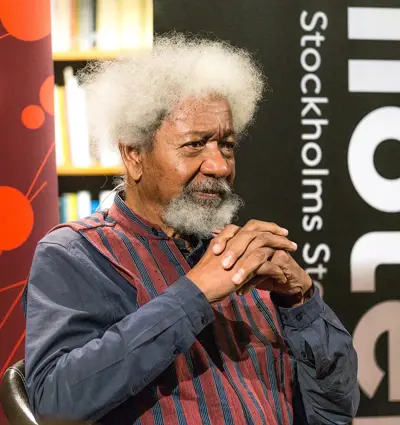
- Born: July 13, 1934
- Nationality: Nigerian
- Profession: Dramatist
Akinwande Oluwole Babatunde Soyinka, known as Wole Soyinka (pronounced [wɔlé ʃójĩnká]), is a Nigerian playwright, novelist, poet, and essayist in the English language. He was awarded the 1986 Nobel Prize in Literature, the first sub-Saharan African to be honoured in that category. Soyinka was born into a Yoruba family in Abeokuta. In 1954, he attended Government College in Ibadan, and subsequently University College Ibadan and the University of Leeds in England. After studying in Nigeria and the UK, he worked with the Royal Court Theatre in London. He went on to write plays that were produced in both countries, in theatres and on radio. He took an active role in Nigeria's political history and its struggle for independence from Great Britain. In 1965, he seized the Western Nigeria Broadcasting Service studio and broadcast a demand for the cancellation of the Western Nigeria Regional Elections. In 1967, during the Nigerian Civil War, he was arrested by the federal government of General Yakubu Gowon and put in solitary confinement for two years.
