Recep Tayyip Erdogan Quotes
The debate is ended. Fifty percent plus one vote is all we need to govern this country.
This quotation illustrates the "winner take all" conceopt of many political cultures that call themselves and think of theselves as a democracy. But a true democracy does not allow a tyranny of the majority--especially a very narrow minority.
Recep Tayyip Erdogan, Speech after barely winning a national plebiscite 51-49, to modify teh Constitution and Give Erdogan almsot dictatorial power and allowing him to escape the term limits of the old constitution, Istanbul, April 16, 2017
Sourced by: Eigen's Political and Historical Quotations


A major problem of new and emerging democracies is that many people believe that majority rule per se is democracy. In Egypt for example, Morsi and his Muslim Brotherhood won the election. They then assumed that they had the right to do anything including exempting the government from judicial review or deciding the role of women in society or denying freedom of religion to non-Muslim citizens. Democracy is not a serial autocracy with each new autocrat being selected by a free and fair election.

The House Rules Committee had evolved into a very powerful committee which controlled the debate rules of every piece of legislation that came before the House. This Congress—the worst in American History—passed fewer bills than any other. Those that ever got out of the Rules Committee had Rules that prohibited the minority from even offering amendments.


This is the major factor in many nations trying to shift to a democracy from a totalitarian form of government. The winners assume that they can now do anything without regard for the minority rights of opinions.


After the many years of the Cold War attacking of Democracy, for many Russians the word conveys a bad image of their old enemy. For others, using the word reminds them that the Soviet Union collapsed and the Russians lost the cold war—an unpleasant memory. Yet many of the leaders of the Russian Federation very much wanted to democratize Russia. Bushmin had this very practical, albeit humorous, solution.

Jefferson thought that the possibility that a man could become President even though more Americans voted for his opponent was undemocratic and a great flaw in our Constitution. It has actually happened several times and each time the Electoral College debate renewed, but there has never been enough concern to produce a Constitutional Amendment.

The version of the Constitution they were debating did not include the Bill of Rights.

The three richest men in America—John D, Rockefeller, Andrew Carnegie, and Morgan, usually major rivals—had gathered together to decide what to do about William Jennings Bryan, who they viewed as very hostile to business and capitalism. (See {641037} and {641038} for Bryan quotation examples that concerned them.) They agreed to combine their efforts and back William McKinley who was running for the Republican Presidential nomination. In those days, the nominee was chosen by a small group of party leaders and their resources guaranteed McKinley the post. They then put large amounts of money to campaigning against Bryan and for McKinley including dirty tricks, many of which are illegal today. It is not known for certain whether McKinley knew the extent of the involvement of the monopolists, but shortly after assuming the Presidency he cut back on many of the relatively few regulations that then existed to control unbridled capitalism. Their effort went for naught when McKinley was assassinated and Theodore Roosevelt became President. Roosevelt would not be bribed or intimidated, and he did more to control monopolies than even Bryan would likely have.
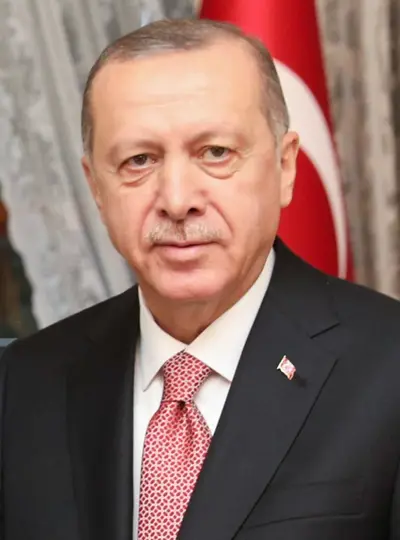
Recep Tayyip Erdoğan is a Turkish politician serving as the current President of Turkey. He previously served as Prime Minister of Turkey from 2003 to 2014 and as Mayor of Istanbul from 1994 to 1998. He founded the Justice and Development Party (AKP) in 2001, leading it to election victories in 2002, 2007, and 2011 before being required to stand down upon his election as President in 2014. He later returned to the AKP leadership in 2017 following the constitutional referendum that year. Coming from an Islamist political background and self-describing as a conservative democrat, he has promoted socially conservative and populist policies during his administration.
