Robert H. Jackson Quotes
The day that this country ceases to be free for irreligion it will cease to be free for religion—except for the sect that can win political power.
Robert Houghwout Jackson, 1892-1954, Chief Prosecutor, Nuremberg War Crimes Tribunal, U. S. Attorney General (Democrat), U. S. Supreme Court Justice, Dissenting opinion, Zorach v. Clauson, April 28, 1952
Sourced by: Eigen's Political and Historical Quotations

This is a critical quotation on the government establishment of religion issue. There are a few people who have argued over the years that the Founding Fathers and their culture was religious and where they were careful to avoid favoring one religion over another, they did NOT intend to put atheism on the same equal plane as religion as far as government action is concerned. However, some of the Founding Fathers were atheists, and some others like John Adams were deists—they believed in a God but not in the Trinity or in Judaism or any organized religion. So this quotation makes it clear that the First Amendment does NOT favor religion over non religion or secularism. Atheism must be on an equal footing but not on a higher plane.


Kennedy was being hurt be fears that as a Catholic, he would be beholden to the Pope and the Catholic Bishops. There were many protestants who believed that the Catholic Church was antithetical to democracy and some who even believed that Catholicism was the religion of Satan. Kennedy decided to confront the issue head on.


Ironically, without the word “wicked” most people would regard the first sentence as a good description of elements of a modern democracy. It illustrates that for the Islamic fundamentalist democracy substitutes the rule of man for the rule of God, freedom of speech allows heresy and blasphemy to to uttered and communicated, and religion which is supposed to inform and direct politics. So what is good for the lover of democracy is the very thing that is bad for Islam. This is not a uniquely Islamic viewpoint. It has been and is held by fundamentalist Christians and Jews as well who would return to Biblical law punishing blasphemy and heresy with death and have religion drive all politics.

This quotation is extremely important because it was completely antithetical to the United States basic philosophy of freedom of religion. Anti-Catholic prejudice which already existed, seized on this quotation to demonstrate that the Catholic Church was a danger to Protestantism and the other religions that had come to America and the many that were created in America. It would take 70 years for the anti-Catholic prejudice had diminished sufficiently to elect a Catholic President—JFK.


While this principle is very clear to us today, and was to the people who originally ratified The Constitution, there were many attempts by Christian groups to establish a privileged position for Christianity. For example, for years the Sunday Sabbath was legally enforced by unconstitutional Blue Laws that prohibited businesses from operating on the Christian Sabbath and prohibited activities that compete with Sunday church attendance. Supreme Court Justice Story even argued that the First Amendment allowed Christian religious supremacy and Cooley wrote this to refute Story’s now discredited doctrine.


At the time there was an issue of religious freedom that is in public discourse: It emanated from the Obama Care law which required employers to provide health insurance that does not discriminate against women by refusing to disallow coverage for birth control (pills, diaphragms, etc.) This legislation covered the employees of general institutions run by religions such as schools, hospitals, and retirement communities. Roman Catholics and other religions which viewed birth control as a sin were put in a position where they had to pay for something that they regarded as sinful. So the church did not have complete religious freedom. However, if these institutions would deny to their employees a basic right that the law says belongs to all institutions. If an exception would be made for birth control what about blood transfusions. The Jehovah’s Witnesses believe that autologous blood transfusions are contrary to the world of God. So what if institutions they run decided to not cover these transfusions in their insurance policies? Or a Jewish University or a Muslim cultural center decided not to cover medical procedures in hospitals that serve pork? There have been many examples where one religion’s freedom has been curtailed slightly when they conflict with individual rights or other rights. Plural marriage for Mormons and Muslims are against the law. Christian Scientists have been forced to provide medical care for some members even though their religion prohibits it. There is no solution that will not curtail someone’s rights under some circumstances.

Bush was trying to obtain the Republican Presidential Nomination and that party had come under the influence of Protestant Evangelicals who could in effect veto any candidate in the Primary election. Bush, who was already suspect with the Evangelicals, chose to make this statement with the full knowledge that there is no Constitutional citizenship requirement to believe in a god and that a number of the leading founding patriots and founders had been atheists. However his tactics were successful and the following year he was the Republican nominee. Despite this statement, he never acted on it or made it a part of his administration’s principles. Politicians are often placed in these difficult positions where they are pressured into positions not to their liking in order to politically succeed. In this case, he never did more than make the disgraceful statement. He did not adopt any policy of take any action. However, this quotation is unique in American history as the only time an American president ever stated that American citizenship should not be recognized for religious reasons only.
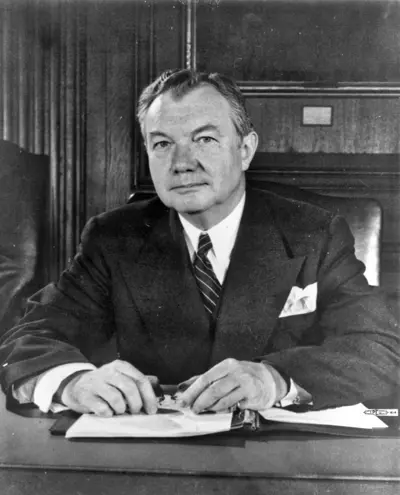
Robert Houghwout Jackson was an American attorney and judge who served as an Associate Justice of the United States Supreme Court. He had previously served as United States Solicitor General and United States Attorney General, and is the only person to have held all three of those offices. Jackson was also notable for his work as Chief United States Prosecutor at the Nuremberg trials of Nazi war criminals following World War II.
