Leo XIII Quotes
It is not lawful for the State, any more than for the individual, either to disregard all religious duties, or to hold in equal favor different kinds of religion.
This quotation is extremely important because it was completely antithetical to the United States basic philosophy of freedom of religion. Anti-Catholic prejudice which already existed, seized on this quotation to demonstrate that the Catholic Church was a danger to Protestantism and the other religions that had come to America and the many that were created in America. It would take 70 years for the anti-Catholic prejudice had diminished sufficiently to elect a Catholic President—JFK.
Leo XIII, 1810-1903, Catholic Pope, Immortale Dei, November 1, 1885
Sourced by: Eigen's Political and Historical Quotations

This quotation is probably the beginning of the false charge that liberalism always rejects God and divine law. Most liberals, since the term has been used, have been religious and even those who were not did not see liberalism as necessarily antithetical towards religion. However, most doctrines of liberality had toleration and religious freedom as part of its foundation. To authoritarian religious leaders who did not believe in toleration (see {609037}) the very toleration of dissenters is tantamount to dissent. Today, for example, many liberals tolerate atheists and non Christian religions even though most are Christians themselves. To some narrow conservatives, this principle of toleration is therefore equivalent to being against religion. To others, modern liberal belief of separation of church and state is seen as anti religious.


Kennedy was being hurt be fears that as a Catholic, he would be beholden to the Pope and the Catholic Bishops. There were many protestants who believed that the Catholic Church was antithetical to democracy and some who even believed that Catholicism was the religion of Satan. Kennedy decided to confront the issue head on.

This quotation is one of the first to make the critical observation that the only time that tolerance of a religion is necessary is when there is an established church and others that deviate from it. If there is no established church, as the Founding Fathers envisioned, there is no preeminent church to do the tolerating. All are equal. In practice, Protestant churches were proportionately dominant in early America and up through the 20th century. So most of the issue of tolerance problems in America were cultural. And there is still a minority of Christians who believe that America should be a Christian country and other religions should be “tolerated.” However, Clinton and most of the founders did not want to see even general Christianity established as the national religion even they it was the majority religion.


The Senate was presented with James Madison’s Language for the First Amendment. These three alternatives were proposed and rejected. The rejected versions turn out to have been very important. Some have argued that the First Amendment does not prohibit Congress making laws regarding religion as long as it doesn’t favor one religion over another—for example pay for clerics of all religions. However, that was the third proposal and it was rejected in favor of the high wall of separation proposed by Madison.


Opponents of the strict separation of church and state use this quotation to support their view. However, Story herein describes public sentiment, not what was passed and ratified in the Constitution and Bill of Rights. See {614309} and {614310} for his statements from the same work that show that there was no question in his mind but that church and state are separated by the Constitution and the First Amendment.


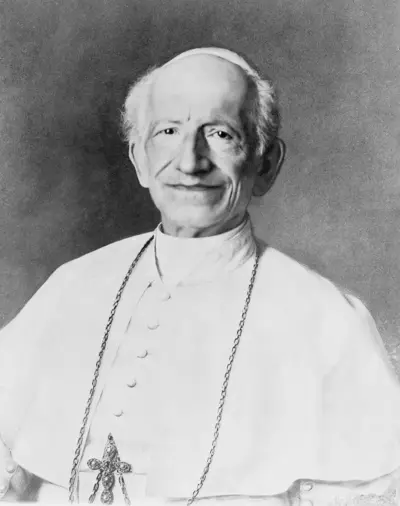
- Born: March 2, 1810
- Died: July 20, 1903
- Nationality:
- Profession:
Pope Leo XIII was the head of the Catholic Church from 20 February 1878 to his death in 1903. He was the oldest pope (reigning until the age of 93), with the exception of Pope Benedict XVI as emeritus pope, and had the third-longest confirmed pontificate, behind those of Pius IX (his immediate predecessor) and John Paul II.
