John Quincy Adams Quotes
The country well knows that by once enlisting under other banners than her own … she would involve herself beyond the power of extrication in all the wars of interest and intrigue, of individual avarice, envy, and ambition, which assume the colors and usurp the standards of freedom.
Adams was not only generally wary of involvement in foreign intrigues but was suspicious of the Greek war of independence in that the Greeks were no more committed to democracy and freedom than the Ottomans were.
John Quincy Adams, 1767-1848, 6th President of the United States (Independent, MA), Response to those who urged him, as then Secretary of State, to intervene in the Greek war of independence from the Ottoman Turks, 1821
Sourced by: Eigen's Political and Historical Quotations

The strong American instinct toward unilateralism, narrowly defined self-interest, and operating under the banner of the United Nations has its traditional roots.

Senator Burton was using this quotation to support the Republican isolation policy that they were advocating at the time. This quotation has been cited by almost every American politician advocating isolationism. Generally it was the Republican party that has been the isolationist advocates in America. However, after the Second World War that began to change, and in the beginning of the 21st century, the George W. Bush Administration, without any declaration of war by Congress, attacked and invaded two different countries starting the Iraq and the Afghanistan Wars. Meanwhile, the Democrats, who had been advocating American activism in foreign affairs also flip flopped and opposed foreign military intervention as Democratic President Obama withdrew American troops from the two Bush wars. The Afghanistan War was the longest war in American history.


In the aftermath of World War I the Greeks invaded Turkish held Smyrna to "protect" the ethnic Greek population there. It was a great military blunder and exposed the Greek military to the Turks. This isI a candid private statement of the fact that admission of a military blunder would cause the government to fall that never was made public,


No military alliances has been a tradition in American politics which broke down and changed in our allied effort in WWI. Harding and the Republicans of his day, wanted to reestablish that principle of American Foreign policy. They succeeded, but WWII and its Cold War aftermath made a major change in U. S. policy on this point, and NATO was not only a major permanent military alliance, but lasted well beyond the fall of the Soviet Union. America and our NATO allies were so pleased with the benefits of a permanent military alliance, that they preserved it by looking hard for missions that it could take on rather than dissolve NATO.

This statement became known as "The Truman Doctrine." Truman asked for $400 million to help Greece and Turkey fight stave off armed Communist minorities destabilizing their governments.

The Serbs were in a conflict with the Ottoman Muslims almost 1000 years ago. However, they have never seen that war as having ended. When the Albanian Muslims were breaking from the weakened Ottoman Empire, the Serbs not only wanted to dominate Albania, but also to extract vengeance for alleged wrongs committed by Ottoman Muslims hundreds of years earlier. This attitude existed through and after the Serbian war and the Kosovo Albanian population would not live under Serbian control given the Serb war crimes and atrocities perpetrated on Muslims—not only in the historical past but even in the Serbian War. Tucovic was one of the very few Serbs who not only argued that the Serbian policy of oppression of the Muslims was not only morally wrong but counter productive from the Serbian point of view. For many Serbs, Tucovic was considered a traitor.

This is an example of the 3 leading democratic powers refusing to recognize the will of the people in other nations in determining their leadership choice. King Constantine I was a demagogue who maintained popularity with the Greeks by constant roiling and urging conflict with Muslim Turkey—the traditional enemy of the Christian Greeks. It was particularly hypocritical in many eyes since President Woodrow Wilson had established the principle of self-determination. However, Constantine I was a disaster for the Greek people. This is one of the earliest situations where American foreign policy support was in conflict between good sense and self-determination. The dilemma has faced America frequently since then and was especially acute in the 2012 “Arab Spring” Egyptian election of the Muslim brotherhood which turned out to be a disaster for Egypt but at an earlier time had won a national election.

The “proofs” were diplomatic assurances—treaties—that England would guarantee the territorial integrity of Belgium. The British made strong diplomatic efforts to persuade Germany not to occupy Belgium. The German’s none the less send armies in under the excuse that if they did not, the French would occupy the country and have a strategic advantage over them. Diplomacy could do no more good. England had to send troops or renege on its obligations. So England was in WWI.


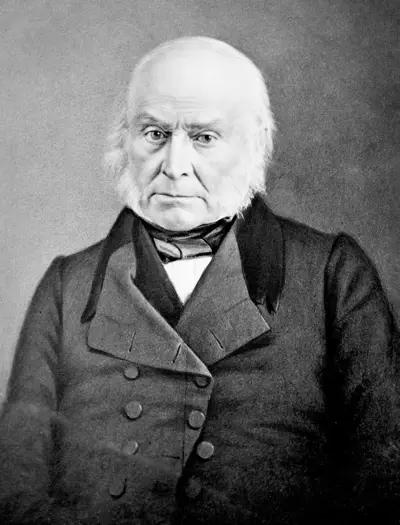
John Quincy Adams was an American statesman, diplomat, lawyer, and diarist who served as the sixth president of the United States, from 1825 to 1829. He previously served as the eighth United States Secretary of State from 1817 to 1825. During his long diplomatic and political career, Adams also served as an ambassador, and as a member of the United States Senate and House of Representatives representing Massachusetts. He was the eldest son of John Adams, who served as the second U.S. president from 1797 to 1801, and First Lady Abigail Adams. Initially a Federalist like his father, he won election to the presidency as a member of the Democratic-Republican Party, and in the mid-1830s became affiliated with the Whig Party.
