Warren G. Harding Quotes
America can be a party to no permanent military alliance. It can enter into no political commitments, not assume any economic obligation or subject our decisions to any other than our own sovereignty.... We will accept no responsibility except as our own conscience and judgment, in each instance may determine.
Warren G. Harding, 1865-1923, 29th President of the United States (Republican, OH), Inaugural Address, March 4, 1921
Sourced by: Eigen's Political and Historical Quotations

No military alliances has been a tradition in American politics which broke down and changed in our allied effort in WWI. Harding and the Republicans of his day, wanted to reestablish that principle of American Foreign policy. They succeeded, but WWII and its Cold War aftermath made a major change in U. S. policy on this point, and NATO was not only a major permanent military alliance, but lasted well beyond the fall of the Soviet Union. America and our NATO allies were so pleased with the benefits of a permanent military alliance, that they preserved it by looking hard for missions that it could take on rather than dissolve NATO.


Inscribed in the John Adams Building of the Library of Congress. On this subject Jefferson was in agreement with George Washington {37176} and his political opponent, John Adams {592705}.

The American sense of exceptionalism of the democratic republic we created and the almost messianic duty to extend freedom and democracy throughout the world is actually relatively new in American history. For most American existence, the sense of the desirability of spreading the American freedom was held from the very beginning, but it was very much inhibited by American isolationist tendencies and entanglements on other nation’s affairs.


England is entering the war against Germany The German war plan called for attacking France through Belgium. However, Belgium was intent on remaining neutral. International law prohibited a neutral country from allowing troops of either side to enter and maneuver in its territory. ({642178}). When Germany moved into Belgium, the Belgians resisted. England had a treaty with Belgium that it would protect Belgian neutrality in the event of any war in Europe. England then sided with Belgium {642175} and committed to send troops to help Belgium oust the Germans. The Kaiser was furious and could not understand that the English would go to war when there was no economic need or advantage for them to do so. Wilhelm II did not have much respect for treaties, promises, or honor other than military honor. He had earlier convinced himself that the English would not fight for a scrap of paper, especially in a land war. {642105}

The “proofs” were diplomatic assurances—treaties—that England would guarantee the territorial integrity of Belgium. The British made strong diplomatic efforts to persuade Germany not to occupy Belgium. The German’s none the less send armies in under the excuse that if they did not, the French would occupy the country and have a strategic advantage over them. Diplomacy could do no more good. England had to send troops or renege on its obligations. So England was in WWI.


England in this quotation claims the right to interfere in the internal affairs of another nation if there is mismanagement or crises AND her national interests are affected.

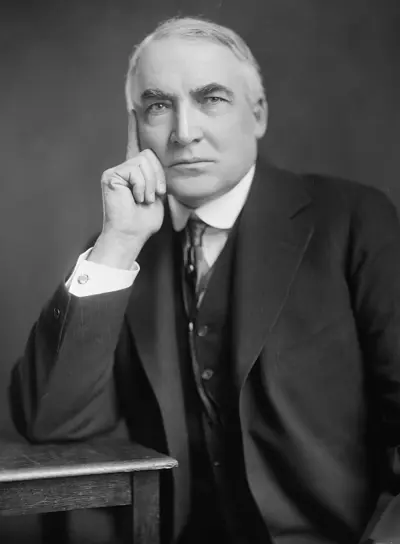
Warren Gamaliel Harding was the 29th president of the United States, serving from 1921 until his death in 1923. A member of the Republican Party, he was one of the most popular U.S. presidents to that point. After his death, a number of scandals, including Teapot Dome, came to light, as did his extramarital affair with Nan Britton; those eroded his popular regard.
