Subramanian Swamy Quotes
The traditional Indian view was to protect our independence; it was therefore quite consistent with the requirements of the time and the feeling of the people. The world may have been misled by Jawaharlal Nehru's own international projection, which in fact had no reality on the ground.
Swamy, Subramanian. "Interview with Subramanian Swamy, 1986." War and Peace in the Nuclear Age, WGBH Educational Foundation, 26 Feb. 1986.


This is another example of how President Roosevelt conducted his own international diplomacy independent of his own State Department. At the time, the U. S. State Department would not have any contact with Nehru who was in and out of British Indian jails for his anti-Colonial agitating. Roosevelt, however was a great admirer of Nehru and the Congress party and the commitment to democracy, freedom of religion, speech and the press and civil rights. Roosevelt and the American military strategic leaders were beginning to worry that China, even with help, would not be able to hold off the Japanese aggression, and India would become a frontier for the Allied war effort. The President realized that Nehru and his Congress Party were pressuring England for independence and extreme Indian nationalists were advocating non-support of the British military effort and strikes and protests to bog down the British army dealing with them instead of fighting the Japanese in Burma and elsewhere. There were a large number of Indian Brigades fighting for the British and if the Indian military volunteers were to be discouraged or boycotted, the allied war effort would suffer. So the President's style was to personally see what he could contribute over and above (and often to the distress of) his agencies established to do the job.

Churchill, out of power at that time, was outraged that the Labour government was about to grant India self-government and independence removing half of the British Empire which he revered. His passion for maintaining the empire was so extreme that it affected his usual great powers of political analysis and prediction. The Congress Party Leaders led India to become the largest democracy the world had ever known, and leaders like Nehru and Gandhi became almost as famous and remembered as was Churchill himself.

Adams was not only generally wary of involvement in foreign intrigues but was suspicious of the Greek war of independence in that the Greeks were no more committed to democracy and freedom than the Ottomans were.


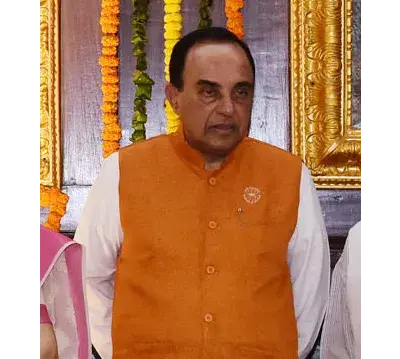
Subramanian Swamy is an Indian politician, economist and statistician, who serves as a nominated Member of Parliament in Rajya Sabha, the upper house of the Indian Parliament. Before joining politics, he was a professor of Mathematical Economics at the Indian Institute of Technology, Delhi. He is known for his Hindu nationalist views. Swamy was a member of the Planning Commission of India and was a Cabinet Minister in the Chandra Shekhar government. Between 1994 and 1996, Swamy was Chairman of the Commission on Labour Standards and International Trade under former Prime Minister P. V. Narasimha Rao. Swamy was a long-time member of the Janata Party, serving as its president until 2013 when he joined the Bharatiya Janata Party (BJP).
