James Wilson Quotes
The connection and harmony between Great Britain and us, which it is in her interest and ours to cultivate; and on which her prosperity, as well as ours, so materially depends, will be better preserved by the operation of the legal prerogatives of the Crown, than by the exertion of an unlimited authority by Parliament.
It was not published and distributed widely until 1774. Some of the Patriots of Early America realized that the oppressions of British rule were coming from Parliament and initially took the position that only the King could make laws for the colonies and not Parliament. Therefore, they were as Englishmen challenging illegal English laws. Most American hostility was directed at Parliament and not the King. However, once there was any physical resistance, King George came down with such a heavy hand that American hatred transferred to him. For related quotes on the King/Parliament issue, see {639145}, {639144}, {639143}, {639142}, {639141} & {639137}
James Wilson, 1742-1798, Legal Philosopher, U. S. Supreme Court Justice, Pennsylvania Delegate to the Continental Congress & the Constitutional Convention, Considerations on the Nature and the Extent of the Legislative Authority of the British Parliament, 1768
Sourced by: Eigen's Political and Historical Quotations


It was not published and distributed widely until 1774. For related quotes on the King/Parliament issue, see {639145}, {639144}, {639142}, {639141}, {639140}, & {639137}

Some of the Patriots of Early America realized that the oppressions of British rule were coming from Parliament and initially took the position that only the King could make laws for the colonies and not Parliament. Therefore, they were as Englishmen challenging illegal English laws. Most American hostility was directed at Parliament and not the King. However, once there was any physical resistance, King George came down with such a heavy hand that American hatred transferred to him. For related quotes on the King/Parliament issue, see {639145}, {639144}, {639143}, {639141}, {639140}, & {639137}
Some of the Patriots of Early America realized that the oppressions of British rule were coming from Parliament and initially took the position that only the King could make laws for the colonies and not Parliament. Therefore, they were as Englishmen challenging illegal English laws. Most American hostility was directed at Parliament and not the King. However, once there was any physical resistance, King George came down with such a heavy hand that American hatred transferred to him. For related quotes on the King/Parliament issue, see {639145}, {639144}, {639142}, {639141}, {639140}, & {639137}

Some of the Patriots of Early America realized that the oppressions of British rule were coming from Parliament and initially took the position that only the King could make laws for the colonies and not Parliament. Therefore, they were as Englishmen challenging illegal English laws. Most American hostility was directed at Parliament and not the King. However, once there was any physical resistance, King George came down with such a heavy hand that American hatred transferred to him. For related quotes on the King/Parliament issue, see {639145}, {639143}, {639142}, {639141}, {639140}, & {639137}

The message was conveyed by the Secretary of State, Sir George Calvert (Lord Baltimore). Parliament and the British King were jockeying for position in their relative powers. King James took the position that Parliament could NOT make laws that affected the American Colonies. Parliament disagreed. Later, some of the American patriots would use this quotation to claim that they were only subject to the King and not to Parliament. For related quotes on the King/Parliament issue, see {639144}, {639143}, {639142}, {639141}, {639140}, & {639137}


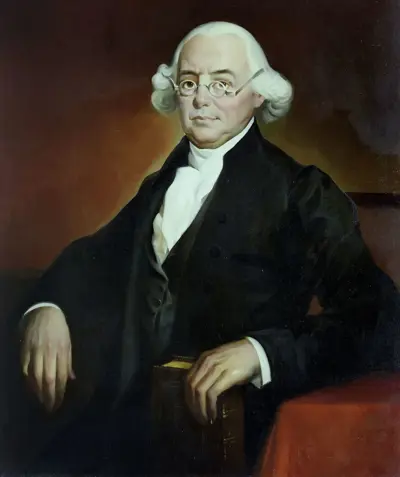
James Wilson was one of the Founding Fathers of the United States and a signatory of the United States Declaration of Independence and the United States Constitution. Wilson was elected twice to the Continental Congress, where he represented Pennsylvania, and was a major force in drafting the United States Constitution. A leading legal theorist, he was one of the six original justices appointed by George Washington to the Supreme Court of the United States.
