Winston Churchill Quotes
The reason for having diplomatic relations is not to confer a compliment, but to secure a convenience.
Diplomatic recognition of the People’s Republic of China was being debated. Many of Churchill’s Conservative Party Colleagues were opposed on the grounds that diplomatic relations gives a signal of legitimacy. In the U. S. this general issue is a constant source of political controversy when diplomatic relations and talks are considered with Iran, Cuba and North Korea.
Winston Churchill, 1874-1965, British Prime Minister (Conservative), Speech, House of Commons, November 17, 1949
Sourced by: Eigen's Political and Historical Quotations


Terrorism even then put strains on traditional diplomacy where bombers would take sanctuary or raise money in countries whose diplomatic policy was opposed to terrorism of all types. At this particular time, Irish terrorists would raise money in the United States to support the terrorists bombing English targets.

The Constitution was not drafted until 1787 and was ratified later. In the interim the young United States functioned under the Articles of Confederation, in a sense, our first Constitution. This clause established that the Federal Government should have the exclusive power and authority to conduct foreign affairs.

There have been times in democracies where a foreign ministry (State Department) is isolated from the elected politicians and implements a foreign policy that is at odds with the wishes of the elected officials and the majority of the nation. A good American example of this was in 1948 where America had to decide whether to support the creation of the State of Israel in the United Nations and through diplomatic recognition. The professional diplomats in the State Department had developed very close relations with Arab States, and many State Department employees were anti-Semitic. In addition, they thought the most important thing for America was not to risk the Arab oil supply. Meanwhile, the people, Congress, and President Truman were on the other side and Truman had to finally order The Secretary of State to stop his professional diplomats from pursuing their own foreign policy preferences. Even then some did not.


There is one condition for us to have healthy relations with the United States. It's called respect.
This is an old and critical concept in American relations with the rest of the hemisphere which Simon Bolivar used to refer to as “respecto.” Americans tend to be relatively unconcerned by what other nations think of America, and since the US has been so successful, it has developed a strong national ego. Other nations, not so successful in modern times, tend to place a great deal of importance on the notion of respect. It is a major factor in most of the world.


In 1904 the Archduchess of Austria was visiting the Adriatic port of Fiume where hundreds of immigrants to America were waiting to board the ship. The nobility of the time found amusement in the poor immigrants boarding with their meager possessions and poor clothes. The Archduchess wanted the people to board 3 days early so she could watch the spectacle before she left. They would then have to stay in the steerage of the ship for 3 extra days. The American consul refused to issue the necessary papers until just before the sailing:

The notion of Executive Privilege developed over the years. Our first President thought nothing of giving the Senate access to all the papers and records regarding the negotiations of the treaty with Great Britain.


“Dey” and “bey” were Arabic terms for the local ruler of an area.


See {640831} for more on this subject.


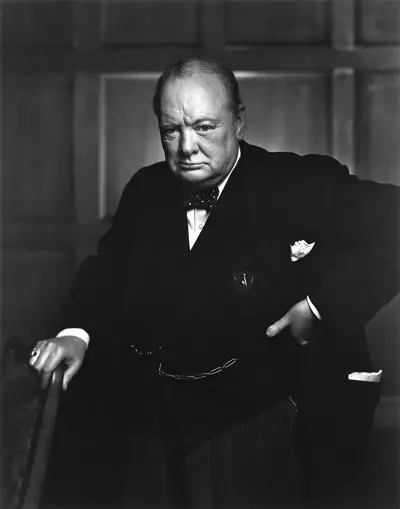
Sir Winston Leonard Spencer Churchill, KG, OM, CH, TD, DL, FRS, RA was the Prime Minister of the United Kingdom from 1940 to 1945, during the Second World War, and again from 1951 to 1955. Apart from two years between 1922 and 1924, Churchill was a Member of Parliament (MP) from 1900 to 1964 and represented a total of five constituencies. Ideologically an economic liberal and imperialist, he was for most of his career a member of the Conservative Party, as leader from 1940 to 1955. He was a member of the Liberal Party from 1904 to 1924. Churchill was also well known for his military career and as a historian, painter and writer, and among his many awards was the Nobel Prize in Literature.
