Eugene V. Debs Quotes
… the bankers are for bullets—for the fool patriots that enlist at paupers' wages to stop the bullets, while the bankers clip coupons, boost food prices, increase dividends, and pile up millions and billions for themselves
This statement during the First World War so frightened the Woodrow Wilson administration that they jailed Debs for saying it and other similar statements like {640245}. The statement was generally suppressed with few newspapers carrying it. The problem for the administration was that enlistments might decrease and force them to draft the wealthy and their sons which was, with very few exceptions, not acceptable to the “upper classes”.
Eugene V. Debs, 1855-1926, Socialist Party Candidate for President, Founder, American Railway Union Quoted in American State Trials: A Collection of the Important and Interesting Criminal Trials which Have Taken Place in the United States, from the Beginning of Our Government to the Present Day, Vol. 13, 1921
Sourced by: Eigen's Political and Historical Quotations

This statement during the First World War so frightened the Woodrow Wilson administration that they jailed Debs for saying it and other similar statements like {640244}. The statement was generally suppressed with few newspapers carrying it. The problem for the administration was that enlistments might decrease and force them to draft the wealthy and their sons which was, with very few exceptions, not acceptable to the “upper classes”.


This was one of the statements that he was jailed for during WWI.


Germany was undergoing a hyper-inflation as the result of a mismanaged economy and the consequence of the First World War. Hitler immediately blamed America and the financers and profiteers. This has been the pattern of almost every government since then that was undergoing a monetary crisis of inflation or deflation—blame the international financers and the Americans.


Leaders of nations for years only trusted as truly patriotic those man—usually nobles of the aristocracy—who owned land. If an invader came and seized their land, they would lose their wealth. However money is fungible, and a banker can easily move his money abroad and join another nation or side in a war. If the country is ruined by war, the manufacturer cannot obtain labor or raw materials, The financier depends on none of these and so hs not the vested interest in the welfare of the nation.


Generally, the robbery he was referring to was white color crime, profits from monopolies, profits made by deviating from laws and regulations, and most frequently by methods that most people think should be illegal and certainly are immoral, but the wealthy have persuaded the Congress and Executive to make many of these thinks legal.


In the Great Recession thousands of bank executives of the banks that received government bailouts committed fraud and perjury providing false information under oath and foreclosing on mortgages illegally. There were so many bank felons that the Justice Department decided not to prosecute any of them and let the Banks pay relatively small fines instead. Then the banks paid the crooked employees bonuses. Paul was one of the few members of Congress who favored prosecution of all the guilty bankers regardless of the number.
Many of the richest people continue to acquire more money via illegal and immoral means. See {630537}.

Money was backed by gold then and therefore limited and the country was growing, and needed more money to finance development. But the only way to then have more money in circulation was for the government to borrow it from the people who had it—mostly wealthy people in the East and in England. These gold owners charged very high interest rates. However there was much more silver in the U. S. and more was being mined every day. So for many populists, the answer was to make silver a basis for money. But those who had gold backed money wanted to maintain the shortage of currency in the growing nation The populists naively thought that if there was sufficient money supply all other problems like labor strife would disappear. Some did when the money supply was finally expanded, but it was no panacea.


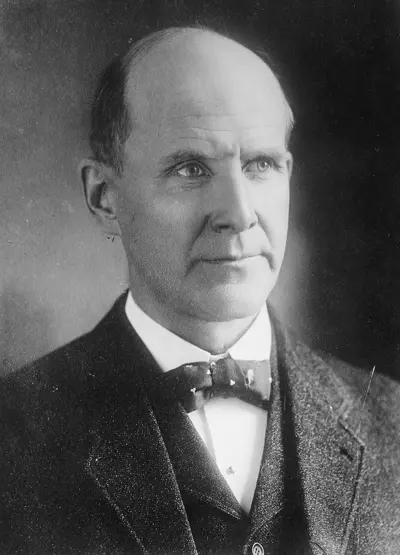
- Born: November 5, 1855
- Died: October 20, 1926
- Nationality: American
- Profession: Politician
Eugene Victor "Gene" Debs was an American socialist, political activist, trade unionist, one of the founding members of the Industrial Workers of the World (IWW) ("Wobblies") and five times the candidate of the Socialist Party of America for President of the United States. Through his presidential candidacies as well as his work with labor movements, Debs eventually became one of the best-known socialists living in the United States.
