William Jennings Bryan Quotes
The poor man who takes property by force is called a thief, but the creditor who can by legislation make a debtor pay a dollar twice as large as he borrowed is lauded as the friend of a sound currency. The man who wants the people to destroy the Government is an anarchist, but the man who wants the Government to destroy the people is a patriot.
William Jennings Bryan, 1860-1925, U. S. Secretary of State, U. S. Congressman (Democrat, NB), 3 Time Unsuccessful Democratic Presidential Candidate, Speech, August 16, 1893
Sourced by: Eigen's Political and Historical Quotations

Summarizing his conclusions of the Judiciary Committee investigations regarding Wall Street and the bankers' role in the Great Depression:


There were little controls over usury in his time in India. Villagers often paid 500% or more to borrow money in a necessity like needing critical health care.

This statement during the First World War so frightened the Woodrow Wilson administration that they jailed Debs for saying it and other similar statements like {640245}. The statement was generally suppressed with few newspapers carrying it. The problem for the administration was that enlistments might decrease and force them to draft the wealthy and their sons which was, with very few exceptions, not acceptable to the “upper classes”.


This is one of the proverbs of King Solomon of the Jews, son of King David.


This is essentially what happened in the Economic Meltdown of 2008 leading to the Great Recession.

In the Great Recession thousands of bank executives of the banks that received government bailouts committed fraud and perjury providing false information under oath and foreclosing on mortgages illegally. There were so many bank felons that the Justice Department decided not to prosecute any of them and let the Banks pay relatively small fines instead. Then the banks paid the crooked employees bonuses. Paul was one of the few members of Congress who favored prosecution of all the guilty bankers regardless of the number.

Money was backed by gold then and therefore limited and the country was growing, and needed more money to finance development. But the only way to then have more money in circulation was for the government to borrow it from the people who had it—mostly wealthy people in the East and in England. These gold owners charged very high interest rates. However there was much more silver in the U. S. and more was being mined every day. So for many populists, the answer was to make silver a basis for money. But those who had gold backed money wanted to maintain the shortage of currency in the growing nation The populists naively thought that if there was sufficient money supply all other problems like labor strife would disappear. Some did when the money supply was finally expanded, but it was no panacea.

Webster was taking regular bribes from large corporations and even complained when his payments were late. So he might have had a pro-large business bias. At the time taking bribes even if there was a quid pro quo was not illegal or even “unethical” by then Congressional rules.

Abrams originated this famous phrase which many have been used subsequently for various “socialized” government benefits that were available to the rich but not the poor. He was referring to the fact that at the time, the government provided housing assistance to the rich by having federally insured mortgages and granting tax deductions for the interest in home mortgages, but there was no assistance to the poor who could only afford to rent and had no tax deductions nor was there any federal public housing assistance. During the Great Recession the phrase was often used when the government gave bail out money to General Motors and the largest banks who were close to bankruptcy, but the landscaping gardener or the hot dog vendor whose business was falling because of the recession were told that is the capitalist system—there are some winners and some losers. The government officials who advocated the bailout did not disagree about the fairness and appropriateness of the Abrams phrase but if they had not bailed the banks out, the entire economic system of the country would probably have collapsed and the ensuing depression would hurt the average worker and the poor even more. Related to the recent “too big to fail” concept.


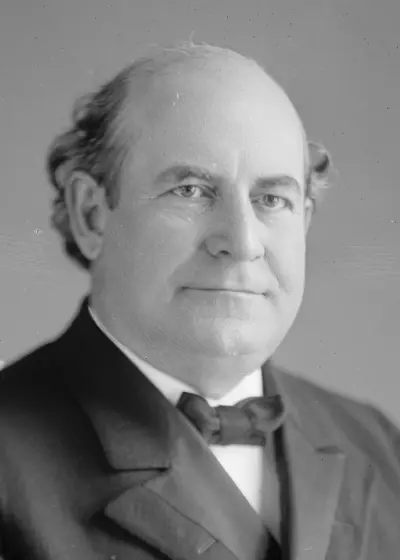
William Jennings Bryan was an American orator and politician from Illinois and Nebraska. Beginning in 1896, he emerged as a dominant force in the Democratic Party, running three times as the party's nominee for President of the United States in the 1896, 1900, and 1908 elections. He also served in the United States House of Representatives and as the United States Secretary of State under Woodrow Wilson. Because of his faith in the wisdom of the common people, he was often called "The Great Commoner".
