Samuel Shaw Quotes
The accumulated hardships under which the army had so long labored made their situation intolerable, and called aloud for immediate redress. An application to the supreme authority of America was thought a salutary measure, and the improbability of obtaining relief from the States individually, after the treatment the Massachusetts line had experienced from their State, rendered it absolutely indispensable.
After the Revolutionary War, the army expected to be compensated and made provision for. But Massachusetts did very little for the Massachusetts line (the state troops were referred to as the “line”.) Shaw and many others looked to the new national government for a solution but a constitution had not even been discussed in convention in 1783 and would not for another 4 years. The Continental Congress could do almost nothing as they had few resources of their own and no power to require the states to do anything.
Samuel Shaw, 1754-1794, Revolutionary War Majorr, First U. S. Consul to China, Letter to Reverend Eliot, April 1783
Sourced by: Eigen's Political and Historical Quotations

After the American Revolution one of the great fears of many of the political leaders was a standing army. So there was little concern about the morale of the officers and enlisted men. Further, the national government and the governments of the individual states were broke. Washington and Hamilton wanted the soldiers to be paid their back wages and saw this as the highest priority for the new nation. Most others did not agree, and viewed the new military back wages as equal to the many other obligations. Hamilton, saw this as an active hostility to the military and was very overt about his castigation of Congress. Washington agreed but was far more diplomatic and could never accept the fact that the military did not owe loyalty to the nation and the Congress.

Mechanics was a general term for people who made things, or fixed things. Ramsay was the first major historian of the American Revolution.

The Continental Army needed everything from uniforms to muskets, mules to food. The British were mobilizing in force. General Washington was pleading for material assistance. Some members of Congress thought the spiritual was as, if not more important. See {583803} for other Continental Congress spiritual contributions to the war effort.

The landowners of New York’s Dutchess County were relatively well to do. They had been enthusiastic supporters of the Continental Congress so that the latter could impress upon the British Authorities the economic injustices but the Dutchess County landowners were less enthused about confrontation over incidents in far away Boston. The plea here was to principle, patriotism and not to self interest.

There is a , romantic American myth about the Militiamen in Colonial and Revolutionary America—the citizen soldiers who would leave their farms and rise to the military necessity of the day. However, not only were the militia very hard to muster to duty, but most actually didn’t own or have experience with firearms, and the prevailing opinion of knowledgeable military leaders from George Washington on down was that the militia were not very good soldiers. See {613015}, {613016}, {613022}, {613027}, {621987}, {621988}, {613030}, {613033}, & {613056}.


Veterans of WWI had been authorized a bonus by Congress, and had been issued certificates, but Congress had not appropriated the money to redeem the certificates. Veterans of World War I formed a “Bonus Army,” some twenty thousand unemployed veterans and a like number of family members arrived in Washington DC with their hurting families and sett up a shantytown across the river from Capitol Hill. They demanded of Congress their bonus pay. Instead President Hoover castigated them and authorized the U. S. Army to disperse the veterans. General Douglas MacArthur commanded the troops and in one of the great disgraces of the United States, he used excessive force, MacArthur attacked women and children with infantry, cavalry and tanks. Governor Bartlett was in Washington at the time and became an eye witness in an era where there was no television.

During the American Revolution, conditions were very difficult for Washington’s soldiers who were ill armed, ill clothed, and ill fed while they were paid irregularly. At one point morale was so low that some of the soldiers revolted. Smyth observes that Washington and Congress disciplined the mutineers very mildly, especially when compared with the way the British would deal with such things. The British Governor Clinton tried to take advantage of the mutiny and the poor morale by announcing that all of Washington’s troops who wished could obtain amnesty and join the British forces where the pay and conditions were much better. Professor Smyth found it fascinating that none of the Americans would join the British and he credits it to the wise and mild discipline policies of Washington and Congress as well as the general perception of the justice of the American cause among the American troops.


America is almost unique among nations where the military has never been a force that either dominated or controlled the government or acted independently from it. The Founding Fathers knew well the history of Europe and other nations, and built many checks into our Constitution and our traditions with George Washington, setting the example for American military men forever after.

Congress and most of the Founding Fathers were very distrustful of standing armies. They were aware that standing armies had taken over societies ever since ancient Rome and Julius Caesar.
This is a very important quotation because it and {641522} show the great difficulty that Washington was under and the fact that he repeatedly asked Congress for assistance very little of which was provided. Washington began to be disillusioned about the militias at this time; see {641525} for the conclusions he reached about the state militias.
This is a very important quotation because it and {641523} show the great difficulty that Washington was under and the fact that he repeatedly asked Congress for assistance very little of which was provided.
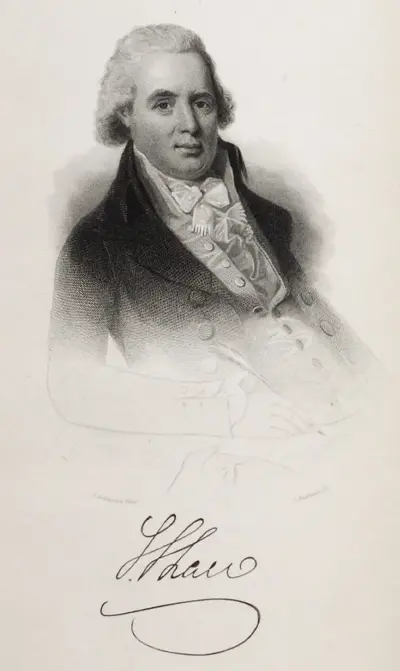
Samuel Shaw was an American Revolutionary War army officer and diplomat, who served as the first United States consul to China.
