Carl von Clausewitz Quotes
Swift and powerful transition to the attack—the lightning sword of retribution — that is the most brilliant part of the defense.
An irony is that Timosheko used German Prussian traditional military strategy to successfully defend against the German invasion of Russia.
Carl von Clausewitz, 1780-1831, Prussian General & Military Writer, Quoted by Russian Miitary Commander Semyon Timoshenko, Autumn, 1941
Sourced by: Eigen's Political and Historical Quotations

Although most of the American Military Experts thought the strategy a loser, Presidential Assistant Harry Hopkins made an inspection trip to Russia and recommended to President Roosevelt that we support Russia. The Russian strategy defeated the Germans but the Russian losses were horrendous—over 20 million killed. See {626597} for the Clausewitz commandment he refers to.

He was a fierce defender of New York City.

This was an incredible order not allowing any Russian Army unit to retreat or surrender. However, it worked. The Russians, with American help of arms, held off the mighty German invading Army. However the German invasion cost the Russians a staggering 22 million lives, mostly civillian.


He was criticizing the George W. Bush administration for attacking Iraq, a country which had not attacked the United States or Americans abroad while America did not attack those terrorists and countries which had killed Americans. For example, Hezbollah which blew up the Marine Barracks in Lebanon and the naval ship Cole.


The general had reported to the Czar that he had peacefully dissipated a protesting mob without firing a shot. The Czar felt that the absence of shooting and killing protesters would simply encourage more protests. See {613675}.

Attila the Hun

While some of the Serbian holidays commemorate loss of battles, the idea of a specific Day of Revenge is new.


Later, he felt that the offense had become almost invincible. See {626741}. Tesla was one of the great American immigrant scientists. He found in America the kind of intellectual and operational freedom that did not exist in the rigid, monarch-controlled, Austro-Hungarian Empire. He developed patents and techniques that formed the technological bases of radio, telephone long distance, TV, cell phones, Wi Fi, just to name a few. Most important he was Thomas Edison’s great nemesis. Edison invented DC electric generators that could power factories or entire streets in a neighborhood. Tesler invented and developed AC electrical technology which could power entire cities and he could move electricity over long distances which Edison could not. Tesler was one of the first scientists to conceive of and try to implement “Big Science” where there were huge capital investments to develop machines and systems to do what had never been done before—philosophically like the CERN Hadron Collider. Tesler even convinced a large corporation to finance the construction of a massive building and tower so he could experiment with the wireless transmission of electricity. However, as the industrial democracies have learned, Big Science can only be funded by governments and it often takes sever working in consort to afford the huge investment that is required. In Tesler’s era, the federal and state governments did not fund scientific research so his work was not only technically ahead of his time but also conceptually. He anticipated most of the problems and need for a national power grid that was challenging America even at the beginning of the 21st century.

Conant, a great scientist in his own right, had the confidence of the political, academic, and industrial establishment and was appointed to the Committee that was to set policy for the Manhattan Project representing President Roosevelt. Germany had been the world leader in Physics before the war. American leaders and scientists were certain that we were in a scientific race with the Germans. Even after Germany had been defeated, President Truman was told that we had beaten the Germans in the race for the bomb. Actually, although almost no one in the US government realized it then, the Germans had NO PROGRAM of nuclear weapons development at all. Hitler did not trust the Theoretical Physics and Theory of Relativity because Einstein and other Jewish scientists had been instrumental in its development. He derogatorily referred to it as “Jewish Science”. Germany bet its scientific efforts on the V2 Rockets and the Jet Airplane, both of which they were successful with but too late to have any material effect on the war. Ironically, even after most of the great German physicists were run out of Germany, there were still two of the greatest who may well have been capable of nuclear weapons development. But neither Werner Heisenberg or Otto Hahn were inclined to engage in that kind of research, and neither of them were even asked whether or not they thought it was possible. The anti-Semitic Nazis just assumed that it could not be. Truman and his associates did not find out for another year or more that there was no race. There was one OSS spy, Moe Berg, who had actually talked to Heisenberg in the midst of the war, and concluded that he not only was not working on an atomic bomb, but was not up on the latest pre-war critical research needed to develop a bomb. Hahn knew and had created the first chain reaction for which he later won the Nobel prize but he was a chemist and didn’t really understand the Physics and mathematics involved in making a weapon and was a confirmed pacifist. Ironically, his colleague, Lise Meitner who had done the physics and mathematics on that experiment was Jewish and had to flee Germany. In Denmark she gave the results to Niels Bohr, who shared them with Leo Slizard and Einstein when Bohr came to the United State and that initiated the famous letter that was sent to FDR which triggered the Manhattan Project. The German first nuclear reaction was used by the Americans because the politicians listened to the scientists, while in Germany, the politicians gave no credence to their scientists and their experiments in nuclear fission.


When the Confederate Government realized that the Union was planning to arm escaped slaves and induct them into the Union Army, they quickly passed a law that declared any escaped slave who joined the Union Army or wore its uniform was guilty of Treason and would be executed. Most Union Generals one way or another got word to the Confederate Officers that they had better treat all Negro Union Soldiers as prisoners of war. Even President Lincoln warned the South. Butler, however, had a large number of Negro troops in his area and had heard threats of some of the Southerners to execute Black prisoners of war. He had a way of making things very clear, and he was able to prevent murder of any of his Negro troops despite the Treason law.

His aggressive tactics which had served him so well in the West got his army into trouble at the Second Battle of Bull Run, where he was out maneuvered by Stonewall Jackson and Robert E. Lee. He was sent back to the West.
There were other factors which Stalin did not mention. There was a major factor of revenge and retaliation. The Germans had killed 22 million Russians (many murdered deliberately), and forced millions of others into slave labor. They had looted everything of value, artistically or commercially from Russian, homes, churches and other buildings. Many of the Russian officers believed that treatment of the Germans was only just given the barbaric behavior of the Germans and applauded by most of the German population.
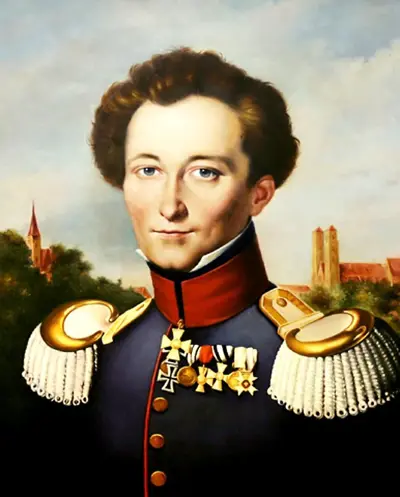
- Born: June 1, 1780
- Died: November 16, 1831
- Nationality: German
- Profession: Soldier
Carl Philipp Gottfried (or Gottlieb) von Clausewitz was a Prussian general and military theorist who stressed the "moral" (meaning, in modern terms, psychological) and political aspects of war. His most notable work, Vom Kriege transl. On War, was unfinished at his death.
