Saint Augustine Quotes
Such then in number and importance are the precious ties belonging to the Christian name which keep a believer in the Catholic Church, as it is right they should ... With you, where there is none of these things to attract or keep me... No one shall move me from the faith which binds my mind with ties so many and so strong to the Christian religion... For my part, I should not believe the gospel except as moved by the authority of the Catholic Church.
Augustine, Saint. St. Augustin: The Writings Against the Manichaeans and Against the Donatists. Translated by Richard Stothert, Christian Literature Publishing Co., 1887, p. 131.


The moral imperative of submission rather than allowing a war started by the aggressor, logical for Pizarro and Church leaders of the time, is the same logic of aggressors from Adolf Hitler to Saddam Hussein.

Ingersoll was considered to be the greatest orator and political thinker of his day, but his overt atheistic views curtailed his elected political career.

In addition to being a Roman Catholic priest, Father Coughlin was an outspoken radio commentator who was well known for his controversial political opinions, see {598783}, {598784}.

This notice of Excommunication was promulgated to the Catholic clergy in Ireland in May of 1538. It required all Roman Catholic leaders to size the property of Protestants or Catholics who sympathized with them. Those who did were then regarded as traitors by the Protestant King. The anti-Protestant feeling culminated with the massacre of about 100 Protestants who were drowned in Bann a few years later.

Much of the Catholic Church was greatly influenced by Aquinas long past his death. This quotation laid the foundation for the view, that anything the Church does, even if seemingly wrong or absurd, has some positive value. Here, Aquinas refused to totally condemn the Church practice of giving indulgences (official absolution for serious sins) to the rich in exchange for money. His view assumes that there must be some good in all acts of the church, even if we can not now determine it. This view makes reform very difficult even after the evil is recognized. Some theologians argue that although this perpetuates some bad practices, it provides stability and prevents leaders of the church from constantly trying to adapt the church to meet current popular or civil criticism.


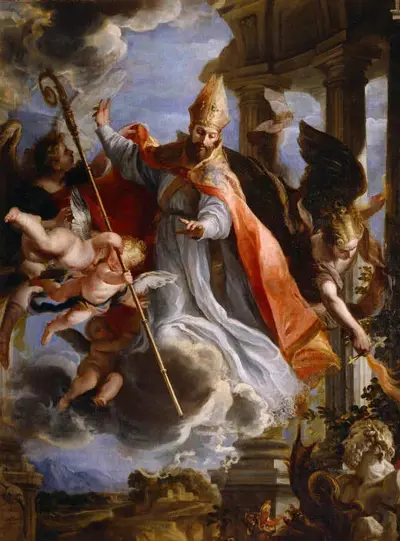
Augustine of Hippo, also known as Saint Augustine, was a theologian, philosopher, and the bishop of Hippo Regius in Numidia, Roman North Africa. His writings influenced the development of Western philosophy and Western Christianity, and he is viewed as one of the most important Church Fathers of the Latin Church in the Patristic Period. His many important works include The City of God, On Christian Doctrine, and Confessions.
