Yasser Arafat Quotes
Since we cannot defeat Israel in war, we do this in stages. We take any and every territory that we can of Palestine, and establish a sovereignty there, and we use it as a springboard to take more. When the time comes, we can get the Arab nations to join us for the final blow against Israel.
Karsh, Efraim. Arafat's War: The Man and His Battle for Israeli Conquest. Grove Press, 2003, p. 55.


This unanimous resolution was one of the major events that triggered the Israeli reaction to Arab plans and actions. The Arabs, organized a unified military command and had cut off the Water to the Sea of Galilee, and Act of War. The 6 Day War soon ensued. The Arabs, as with each of their wars, ended up with a worse position than before the aggression.


To make matters worse for the Muslims, the tiny foreign entity in their midst—populated by "heathens who do not follow the command of God"—have created a much higher standard of living for their people, improved the land and its productivity in ways that have been far superior to traditional Islamic methods, reclaimed much of the desert that the Muslims could not, and produced a military that has staved off the hostilities of all of Islam, and has done all this without any oil or other natural resources to sell. Israel is a living counter-example to the superiority of Islam and its traditions which is so important to Muslims.


The Arab League Members have historically been at each others throats with little concordance except hatred of Israel and Jews


”Palestine” to the Arabs of the area meant the territory of the West Bank, Gaza, and Israel itself. They wanted to expel the Jews and or take over the whole area as a single state—Palestine—with an Arab majority. With the Israeli Defense Forces successes under Dayan, this notion of Palestine was “finished”. The notion of a Palestinian State which included the West Bank and Gaza but not Israel was then negotiated and these negotiations were ongoing for years. Minorities of Arabs and Israelis did not want to see a any Palestinian state that did not include Israel proper, and they blocked it whenever they could.

This statement hardened the Israeli population away from anything that would bring Hamas more power. The PLO leader had, for ALL the Palestinian people, recognized the right of Israel to exist {633062}. Now Hamas was not only reneging on the Arafat declaration, but also would not even use the term “Israel” and instead calls the nation which in less time than the Palestinians have had, has developed a modern, industrial, democratic state far in advance of the Palestinians or any of the Arab nations for that matter. Yet it is relegated to a “project” with the great hope of having it come to an end—the destruction of Israel. The Israelis observe that this is a de facto declaration of war, and hence treat Gaza and Hamas as an enemy force to be reckoned with. See {635338} for another alarming reneging of the recognition of Israel.

The “radicals” refer to the extremely conservative, religiously-oriented Israelis. To them the only real and important element is the land that God gave to the Jewish people. They see the State as artificial and whose only legitimate role is to protect and defend the land of Israel. God has ordained the laws in the Talmud—the first 5 Books of the Old Testament. They do not believe in democracy but seek a Hebrew Theocracy of the Ancient Jews before they made the error of having kings. Some of them opposed the civil government of Israel when the country was founded via a UN resolution and a few would not even defend the new country under a civil government. The relative moderates see Israel as a nation state where the land of Israel can be changed, negotiated, traded as other nations do with their borders. One irony is no one knows exactly the borders of the land which God gave to the Jews and this is why archeology is so politically important in Israel compared to other countries.

Hamas, a terrorist organization controlling Gaza at that time had fired a thousand missiles into Israel. To stop them, the Israeli Defense Force using air power destroyed hundreds of Hamas facilities and homes of Hamas leaders. They also killed many Hamas terrorists, but at the same time there were also civilian casualties including women and children. Some critics of Israel formulated a moral equivalence between the two sides especially since the Israeli’s had anti-missile defense that exploded most of the missiles in flight. The Israeli Prime Minister explained the moral and ethical distinction. The Israeli’s did not strike any building without warning; they always notified the population in advance as to which target would be hit—something that no other nation had ever done in an armed conflict. However, Hamas forced many civilians to remain in the targeted buildings and almost all of the civilian casualties were to the civilians who Hamas decided to sacrifice. The facilities attacked were all places where Hamas had stored weapons or were command and control facilities, or were used for planning terrorist activities or were the residences of Hamas fighters of high rank. All these are legitimate targets under the rules of war, and the military force that uses them are responsible for clearing the civilians out. In this case, the kept them in, and in many cases sent them in, so that the Israeli military forces would be accused of injuring or killing innocent civilians.

Israel's Arab enemies do not simply want to control the territory and/or the economic resources. Their aim, overtly stated thousands of times since the formation of Israel, is to "drive the Jews into the sea", murder the population, obtain revenge for their percieved humiliation that "foreigners" to the region and their religion could build a society so far advanced compared to Arabs on the harsh land abd without any of the oil riches that some of the Arab states had. Israel has won all the wars that the Arabs have initiated, and never murdered the population, and provide the "occupied territiries" with better medicine and infrastructure than the Arabs achieve on their own.


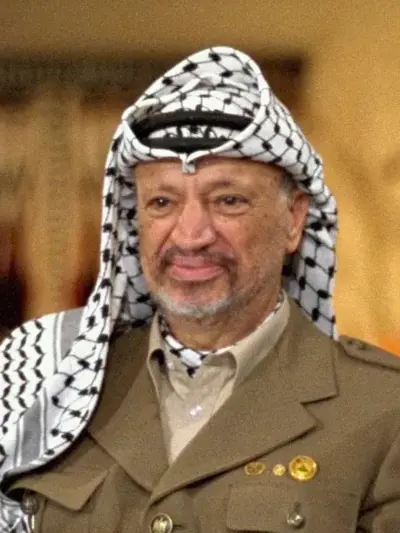
Mohammed Yasser Abdel Rahman Abdel Raouf Arafat al-Qudwa al-Husseini, popularly known as Yasser Arafat (Arabic: ياسر عرفات, romanized: Yāsir ʿArafāt) or by his kunya Abu Ammar (Arabic: أبو عمار, romanized: ʾAbū ʿAmmār), was a Palestinian political leader. He was Chairman of the Palestine Liberation Organization (PLO) from 1969 to 2004 and President of the Palestinian National Authority (PNA) from 1994 to 2004. Ideologically an Arab nationalist, he was a founding member of the Fatah political party, which he led from 1959 until 2004.
