Frederick Barbarossa Quotes
Since by the ordination of God I both am called and am Emperor of the Romans, in nothing but name shall I appear to be ruler if the control of the Roman city be wrested from my hands.
Bryce, James. The Holy Roman Empire. Macmillan and Co., 1904, p. 167.

The priest had come to the Empress to complain about the debauchery of her Prime Minister and made the error of describing him as the first man of the empire. The story may be apocryphal but it illustrates the character of the Empress. The source of the exact words are given in the historical novel, Luise Muhlbach, Joseph II. and His Court


She was running for the United States Senate. God must have chosen her opponent as she lost.


His official title was: “President for Life, Protector of the People, Maximum Chief of the Revolution, Apostle of National Unity, Benefactor of the Poor, Grand Patron of Commerce and Industry, and Electrifier of Souls”. He made a mockery of his statement that the people are the source of all power.


Joseph ben Matthias. There a different kinds of theocracy, There can be a Pope, a King, or a Supreme Leader who acts as the chief magistrate using a religious tract as the law of the land. The Ancient Jews had a Republican Theocracy were the leaders were chosen by the people but they did not promulgate any laws. The Torah—the first 5 books of the Old Testament—was the law of the land. In comparison. 21st century Iran recognized the Koran as the source of Laws. However, their chief magistrate was a cleric—the supreme leader who is not elected but appointed by a few other clerics. None of the other Iranian leaders are chosen by the people because all candidates must be approved by the Supreme Leader in order to even stand for election. So the ancient Jews had a republican theocracy, while Iran was an autocratic theocracy.

of the monarch of Spain See {629456} for a good example of this.

This quotation illustrates the negative attitudes towards democracy that existed with many “leaders” of the time. Stuyvesant was appointed by and reported to the Dutch West India Company—not to the government of Holland. New Amsterdam was a commercial venture just as most of the English American Colonies were. Stuyvesant was not a particularly good governor in terms of both making money for the company or governing the new city.


England had, under Henry VIII, left the Roman Catholic Church where the King replaced the Pope as head of the English Church. Henry’s successors then had to organize and manage the national Christian church. James was discussing the hierarchy of the Church of England and there was a suggestion that Bishops be eliminated and have every priest directly responsible to the crown. Bishops would be powerful figures who might form a power center. (They did later). However, King James I observed that the King is God’s choice and rules by divine right. So there had to be bishops to crown kings. The bishoprics were retained.


It is you who have called us unto this office; but being thus called we have our authority from God;
Then the Deputy Governor, Winthrop had been attacked as being too authoritarian. The conceptual struggle with democracy, divine right, and religion had begun in America long before the American Revolution. There is an interesting parallel with the current debate over Islamic attacks on democracy by an Islamic party being elected, but then responsible to God and not only the people who elected them.

See the Massachusetts General Court for a democratic twist on this view.

The MDC was the opposition party which won the election which Mugabe would not recognize.

See {43619} for a contradictory view of the Emperor.
This concept was later formalized in British law. See Blackstone.
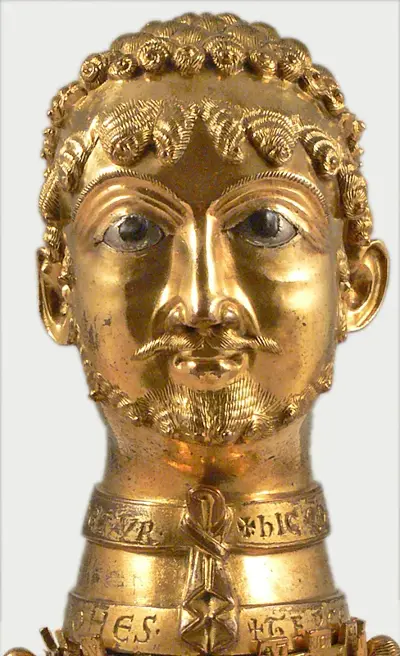
Frederick Barbarossa, also known as Frederick I, was the Holy Roman Emperor from 1155 until his death 35 years later. He was elected King of Germany at Frankfurt on 4 March 1152 and crowned in Aachen on 9 March 1152. He was crowned King of Italy on 24 April 1155 in Pavia and emperor by Pope Adrian IV on 18 June 1155 in Rome. Two years later, the term sacrum ("holy") first appeared in a document in connection with his empire. He was later formally crowned King of Burgundy, at Arles on 30 June 1178. He was named Barbarossa by the northern Italian cities which he attempted to rule: Barbarossa means "red beard" in Italian; in German, he was known as Kaiser Rotbart, which has the same meaning. The prevalence of the Italian nickname, even in later German usage, reflects the centrality of the Italian campaigns to his career.
