Maria Theresa Quotes
Know, sir, that the first place in the empire is mine. From God I hold my power and my crown, and I depute them to no man--I alone reign in Austria.
The priest had come to the Empress to complain about the debauchery of her Prime Minister and made the error of describing him as the first man of the empire. The story may be apocryphal but it illustrates the character of the Empress. The source of the exact words are given in the historical novel, Luise Muhlbach, Joseph II. and His Court
Maria Theresa, 1717-1780, Empress of Austria, Statement to Father Porhammer
Sourced by: Eigen's Political and Historical Quotations


William the Conqueror. See Henry of Huntington for another similar description of the King's authority.


She was Queen of Scotland and claimed the English throne as well. While Elizabeth I was on the throne of England, Mary claimed that the court had no jurisdiction over an absolute monarch. Her son was in France at the time but eventually succeeded to the Scottish throne as James VI and the English throne as James I.

Province of the Congo. Both the British and the Belgians were vying for Katanga to become a part of their empire. Msri, a cruel tyrant, was hated by his people, many of whom he had had murdered.

This phrase was used on all royal decrees and it accurately reflected the Bourbons “divine right” to rule


His official title was: “President for Life, Protector of the People, Maximum Chief of the Revolution, Apostle of National Unity, Benefactor of the Poor, Grand Patron of Commerce and Industry, and Electrifier of Souls”. He made a mockery of his statement that the people are the source of all power.


Bartolomeo Fiadóni -- Tolomeo da Lucca -- Bartholomew of Lucca

The assumption of one supreme authority being necessary for a state, has been the most common assumption in almost all cultures and times before the American Revolution. What is amazing is that the Founding Fathers rejected this notion in favor of our complex system of checks and balances restrained by a Constitution which no society had ever tried before. England in contrast as it became more democratic, simply shifted the supreme, uncontrollable entity from the King to the Parliament which it is even today. Parliament can do virtually anything unrestrained by anything except their judgment and tradition.


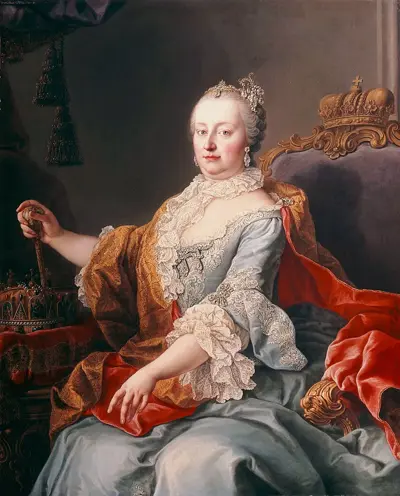
Maria Theresa Walburga Amalia Christina was the only female ruler of the Habsburg dominions, ruling from 1740 until her death in 1780. She was the sovereign of Austria, Hungary, Croatia, Bohemia, Transylvania, Mantua, Milan, Lodomeria and Galicia, the Austrian Netherlands, and Parma. By marriage, she was Duchess of Lorraine, Grand Duchess of Tuscany and Holy Roman Empress.
