William Blackstone Quotes
In every political community there must be one supreme, irresistible, absolute, uncontrolled, authority.
The assumption of one supreme authority being necessary for a state, has been the most common assumption in almost all cultures and times before the American Revolution. What is amazing is that the Founding Fathers rejected this notion in favor of our complex system of checks and balances restrained by a Constitution which no society had ever tried before. England in contrast as it became more democratic, simply shifted the supreme, uncontrollable entity from the King to the Parliament which it is even today. Parliament can do virtually anything unrestrained by anything except their judgment and tradition.
William Blackstone, 1723-1780, British Jurist, Quoted in Daniel Hulsebosch, “The Plural Prerogative”, William and Mary Quarterly, October 2011
Sourced by: Eigen's Political and Historical Quotations

This was a prevailing philosophical view in England and other monarchies. American Founding Fathers were quite familiar with Hobbes’ works and views and many specifically rejected it. Some of the Federalists wanted to extend some of the traditional prerogatives of monarchy to the American Presidency while the Jeffersonian Republican Democrats wanted the executive treated like any, one else before the law. Today that view generally holds, but there is a vestige of the Hobbes’ view still present in things like Executive Privilege.


He was then the Chancellor of the Exchequer.


This seems to be the first time the Latin saying, first among equals, has been applied to the British Prime Minister within the Cabinet.


After the King’s appointment in 1921 she “advised” him on establishing this regime and operating the government. At a time that women could not even vote in England, Bell was a kingmaker and major power in an area of the world that was much more sexist than England at the time.


The priest had come to the Empress to complain about the debauchery of her Prime Minister and made the error of describing him as the first man of the empire. The story may be apocryphal but it illustrates the character of the Empress. The source of the exact words are given in the historical novel, Luise Muhlbach, Joseph II. and His Court


1st Baron Macaulay


3rd Viscount Palmerston. Lajos Kossuth was the Hungarian leader of anti-monarchists who were agitating for a Parliament. While many English people sympathized with Kossuth, his government, which had good relations with England, did not want any of the other European Governments to officially meet with him. It was considered insulting to a government if a friendly government met officially with a politician who was not approved by his own government. Palmerston, as Temple was referred to, wanted to show English sympathy with the reforms advocated by Kossuth. He was then the Foreign Minister and wanted to invite Kossuth to the Foreign Ministry. However the Cabinet had a meeting and voted against the idea which would not only inflame the Hungarian government, but would outrage all the other countries in Europe for this diplomatic insult. Palmerston then decided that he would meet with Kossuth in his private residence. When the Prime Minister discovered this plan, he sent a note by messenger telling Palmerston that he was the Foreign Minister and inviting Kossuth to his home could not be seen as an official action. Palmerston has his own political base and had enough supporters in Parliament that if he would be fired, he could bring down the coalition government. So in effect he told his Prime Minister off and dared Russell to fire Palmerston. Then he went ahead with the meeting. The cabinet was upset, Queen Victoria was outraged (she never cared for Palmerson as a Foreign Minister), the Newspapers had a field day, and all the European counties complained vehemently to the Queen and the Prime Minister. But Russell didn’t dare fire Palmerston at that point. However, with Queen Victoria’s shrewd political maneuvering and Russell coalescing support, he was able to demote Palmerson to Home Secretary and assume the Foreign Ministry himself in 1952. However, Palmerston had the final winning hand, when 3 years later, he was elected Prime Minister and he and the Queen had to make a rapprochement.


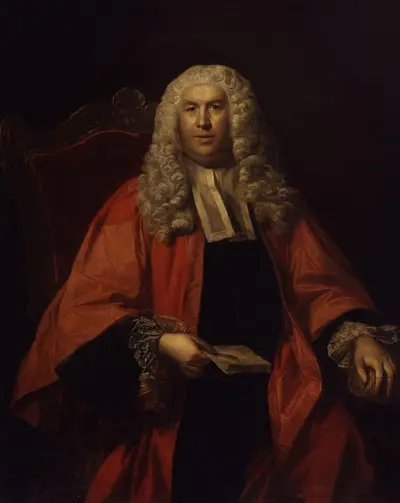
Sir William Blackstone SL KC was an English jurist, judge and Tory politician of the eighteenth century. He is most noted for writing the Commentaries on the Laws of England. Born into a middle-class family in London, Blackstone was educated at Charterhouse School before matriculating at Pembroke College, Oxford, in 1738. After switching to and completing a Bachelor of Civil Law degree, he was made a fellow of All Souls, Oxford, on 2 November 1743, admitted to Middle Temple, and called to the Bar there in 1746. Following a slow start to his career as a barrister, Blackstone became heavily involved in university administration, becoming accountant, treasurer and bursar on 28 November 1746 and Senior Bursar in 1750. Blackstone is considered responsible for completing the Codrington Library and Warton Building, and simplifying the complex accounting system used by the college. On 3 July 1753 he formally gave up his practice as a barrister and instead embarked on a series of lectures on English law, the first of their kind. These were massively successful, earning him a total of £453 (£71,000 in 2021 terms), and led to the publication of An Analysis of the Laws of England in 1756, which repeatedly sold out and was used to preface his later works.
