Samuel Johnson Quotes
All government is ultimately and essentially absolute.
See the Massachusetts General Court for a democratic twist on this view.
Samuel Johnson, 1709-1784, English Writer & Lexicographer, On the American Revolutionaries, 1775
Sourced by: Eigen's Political and Historical Quotations


He was then the Chancellor of the Exchequer.

Lippmann was the most influential pundit of the time. Roosevelt had just been elected but had not yet assumed office. The country was in the midst of the Great Depression and many communities had 80% unemployment. Banks had failed, people were starving, and many people thought that democracy was just not suited to deal with such severe problems. Roosevelt, however rejected the advice and always worked through the Congress and in so doing saved democracy in America.


Arguing the need to limit the power of the legislature:

This was a prevailing philosophical view in England and other monarchies. American Founding Fathers were quite familiar with Hobbes’ works and views and many specifically rejected it. Some of the Federalists wanted to extend some of the traditional prerogatives of monarchy to the American Presidency while the Jeffersonian Republican Democrats wanted the executive treated like any, one else before the law. Today that view generally holds, but there is a vestige of the Hobbes’ view still present in things like Executive Privilege.


Eggleston was an accomplished writer who had served in the Confederate army of the Civil War. 20 year after the war he wrote a series of articles for the prestigious Northern Atlantic Monthly trying to convey the war from the Southerner’s point of view.
Eggleston was an accomplished writer who had served in the Confederate army of the Civil War. 20 year after the war he wrote a series of articles for the prestigious Northern Atlantic Monthly trying to convey the war from the Southerner’s point of view.

FDR was a marvelous judge of men and their character. De Gaulle could not separate himself from France and pushed the French Republic towards one man rule (himself) as much as anyone since Napoleon Bonaparte.

At the time of this statement most people thought that Bush was joking. But by the end of his Presidency many looked back on the quote and thought that Bush had such preferences. He unilaterally took the country into the Iraq War and assumed Presidential Powers that no other president had ever attempted. Most serious, his administration actually took the formal legal position that the President did not have to obey the law if he unilaterally thought that it was not in the nation’s interest from the point of view of the Commander in Chief. So many debate whether this quotation was a light hearted joke of a harbinger of his real feelings about the Presidency.
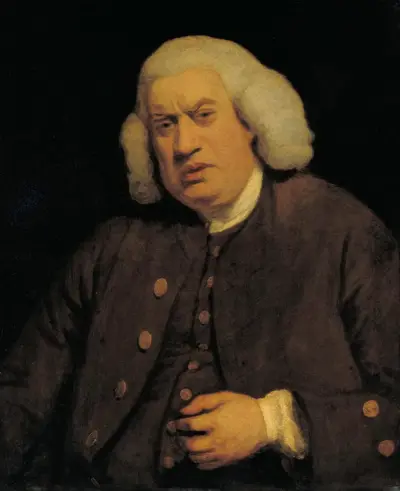
Samuel Johnson, often referred to as Dr Johnson, was an English writer who made lasting contributions to English literature as a poet, playwright, essayist, moralist, literary critic, biographer, editor, and lexicographer. Religiously, he was a devout Anglican, and politically a committed Tory. The Oxford Dictionary of National Biography describes Johnson as "arguably the most distinguished man of letters in English history". He is the subject of James Boswell's The Life of Samuel Johnson, described by Walter Jackson Bate as "the most famous single work of biographical art in the whole of literature".
