Saint Augustine Quotes
Samson crushed himself and his enemies to death beneath the ruins of a building. He can only be excused on the grounds that the Spirit of the Lord, who wrought miracles through him, had bidden him to do so. But, apart from such men excepted by the command of a just law in general or of God, the very Source of justice, in a special case, any one who kills a human being, himself or another, is guilty of murder.
Augustine of Hippo. The City of God. Translated by Marcus Dods, Modern Library, 1950, p. 27.

This proverb only makes sense in the light of understanding the Arab concept of revenge—“blood.” In a rural desert environment where little can be expected of government, the Arabs have developed a law enforcement and peace keeping mechanism which while primitive from modern standards, nevertheless worked to some degree. It is that revenge—“blood” is a moral necessity and obligation of all people, and revenge is not limited by time or to the individuals involved in the first incidence. The immediate family are the first to extract revenge, but the extended family follows and often the entire clan. Sometimes revenge is tribal or even national. Anyone who fails to revenge a member in his group is not only a disgrace, but is a clear and present danger to the group because then they can be attacked with impunity. So revenge is a strong obligation of the group members and blood must be paid with blood no matter how many generations it may take. The only thing that keeps me and my family safe, is the surety what whosoever kills one of us will themselves be killed or if they die a natural death we will take revenge on one of the evildoers relatives. Crime must never pay!

Nathaniel Bacon had led a rebellion in Virginia and had routed the Governor’s troops and caused him to flee leaving control of Virginia to Bacon and his followers who were far more democratic and advanced. However Bacon succumbed to swamp fever, and his followers could not hold the colony together giving the Governor a chance to establish his authority. He then went on a vengeful reign of terror, executing all of Bacon’s followers he could get his hands on. With no danger to the authority of the Crown, King Charles felt that Berkeley had gone too far. The King’s father Charles I had been executed in the aftermath of the English Civil War, but he had executed far fewer than Berkely had done in Virginia.


Manava Dharma Shastra. This text is a part of the Hindu Holy Texts. Hindus believe that Mahu was a prophet whose text is revealed or inspired.


This sura on retaliation for murder is behind the Saudi Arabian law which allows the male relative of a murder victim to personally wield the sword in the beheading of the murderer.


Mandelstam was later sent to a Soviet gulag for writing a poem denouncing Stalin. He died there.


Her view was only held by a few British citizens. Capital Punishment was ended in Britain.

He was describing a real case in Canada. There as well as the United State, for those who oppose capital punishment give as their main reason the mistakes made by the criminal justice system, and the innocent people who have been executed.

Later, in 1973, he himself was denounced and sentenced to the guillotine. When he was sentenced, hecklers asked him if his blood was too pure for execution throwing his quotation back at him.


Actually under Islamic law teh relatives of the victems can grant mercy, and they are frequently paid money by the family and friends of the accused murderer to do so. in many cases, the wealthy offender can avoid even long jail terms. However, if the victim's family is also very wealthy, they would often exact vengeance and have the killer executed. This is one major difference between must Western law and Islamic law. In the West we do not giver the relatives of the victim any significant role in the process. Vengeance is not recogniszed and it is society that acts. Recently some states have allowed victim families to man imact statment s to the jury or judge. There had been an aborted revolution and several hundred Turks were killed in the battles betwen the revolutionists and the police and non-revolutionary soldiers.

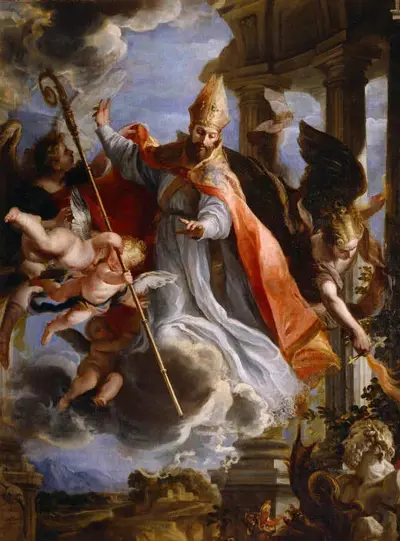
Augustine of Hippo, also known as Saint Augustine, was a theologian, philosopher, and the bishop of Hippo Regius in Numidia, Roman North Africa. His writings influenced the development of Western philosophy and Western Christianity, and he is viewed as one of the most important Church Fathers of the Latin Church in the Patristic Period. His many important works include The City of God, On Christian Doctrine, and Confessions.
