Ruhollah Khomeini Quotes
Reality must be faced. The main problem facing your country is not one of private ownership, freedom and economy; your problem is the absence of true faith in God.
The irony of his lecturing the Russians was that the revolutionary regime he founded in Iran, which had faith in God, was terribly unpopular with the Iranian people precisely because of the lack of private ownership and freedom and a moribund economy. The ruling religious elite in the Iranian theocracy had to ban popular leaders from standing for election in order to maintain control of a country where most people preferred the very things that Khomeini and the other Ayatollahs advised were unimportant.
Ruhollah Khomeini, 1900-1989, Iranian Cleric [Ayatollah] & Revolutionary Leader, Letter to Russian Premier Gorbachev, January 1989
Sourced by: Eigen's Political and Historical Quotations


Husayn Ali Nuri. This quotation illustrates one of the reasons that the Muslim Iranian fundamentalists are so fearful of Bahai, a reform offshoot of Islam. For the orthodox Muslim there must be no separation of church and state—they are one and the same. The Bahai minority of Iran have been hunted down and in many cases killed on the grounds that they were heretics and blasphemers.


This verse has been one of the bases of Muslim theocratic states like Iran’s claim to legitimacy. The word “govern” is sometimes translated as “judge.” In the context of the 6th century, there were no separation of powers as we know them and judging, governing and legislating were melded.
This verse has been one of the bases of Muslim theocratic states like Iran’s claim to legitimacy.


The import of this principle is that if a member of the family is not a good Muslim, then that member is no longer to be treated as and is not a relative any longer. Qutb cites the example of Abdullah bin Abdullah bin Ubayy, a contemporary of the Prophet’s whose father had opposed Islam and therefore must be punished. He quotes the man as telling the Prophet: ‘if it is the pleasure of God and His Prophet that I cut off my father’s head, then I shall do so.’

He was running for the Republican Presidential nomination at that time.


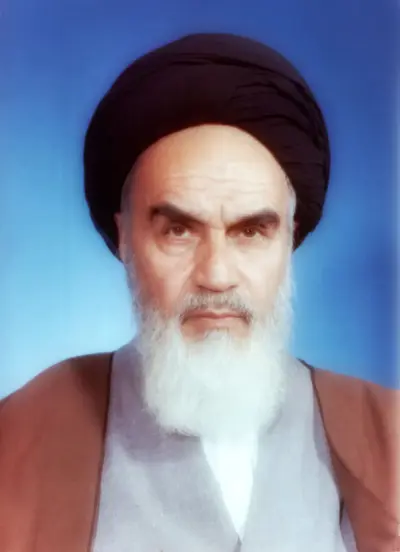
Sayyid Ruhollah Musavi Khomeini, also known in the Western world as Ayatollah Khomeini, was an Iranian political and religious leader. He was the founder of the Islamic Republic of Iran and the leader of the 1979 Iranian Revolution, which saw the overthrow of the last Shah of Iran, Mohammad Reza Pahlavi, and the end of the 2,500-year-old Persian monarchy. Following the revolution, Khomeini became the country's Supreme Leader, a position created in the constitution of the Islamic Republic as the highest-ranking political and religious authority of the nation, which he held until his death. Most of his reign was taken up by the Iran–Iraq War of 1980–1988. He was succeeded by Ali Khamenei on 4 June 1989.
