John Jay Quotes
Providence has given to our people the choice of their rulers. And it is the duty as well as the privilege and interest, of a Christian nation to select and prefer Christians for their rulers
Objectors to the Separation of Church and State Doctrine point to this quotation to justify giving preferences to Christians in majority Christian societies and presumably to prefer Muslims in Islamic nations. Most of the Founding Fathers and most of the general population were on the opposite side of this issue. Hence the First Amendment was one of the conditions for ratification. There has always been a large minority who believe that America was founded by people who were mostly Christian (Protestant) and there is nothing wrong with having America be a Christian nation and preferring Christians for key government positions.
John Jay, 1745-1829, President of the Continental Congress, Governor of New York (Federalist), U.S. Foreign Secretary, First Chief Justice of the U. S. Supreme Court, Letter to Jedidiah Morse February 28, 1797
Sourced by: Eigen's Political and Historical Quotations

Some other Republican governors thought that Fordice had misspoken and offered him a chance to correct or modify his statement. He declined.


The argument over whether or not the Founding Fathers intended a religious—Christian—foundation in the formation of America is not just a debate of modern times, but has been debated even in the next generation of politicians. Webster, believed that it was.


Lopez and Elizer were Jews who had escaped the persecution in Portugal to come to America. They and other non-Christians could live and work in Rhode Island but could not vote or hold public office by a previous decision of the Rhode Island Assembly. See {619707}.The Jews had petitioned for their civil rights.


Her distorted historical view of the intentions of the Founding Fathers contradicts just about everything most said and wrote at the constitutional convention and otherwise. There was a small minority of very fundamentalist Christians who had an established church model in mind but most had observed the disasters in England and the rest of Europe brought by religion in government, and also had the problematic history of early American colonies with religion and politics. Also, at the time there were already over a dozen different substantial religions in the colonies as well as a number of non-religious and dissenter colonists. Even though there was no established church or any of the aspects of religion in government as Ms. Harris prefers written in the original constitution, the American people wanted to be so sure of that separation that they required the First Amendment in order to obtain ratification. On the other hand Ms. Harris had one strong aspect to her argument. She knew what God wanted, while her opponents and most Americans did not have that insight.


In 1996 the Tennessee Senate passed a resolution to post the Ten Commandments in homes, schools and businesses. Cohen was then a Senator of the Tennessee State Legislature.

This proposal and others like it over the years have never even gotten out of Committee.

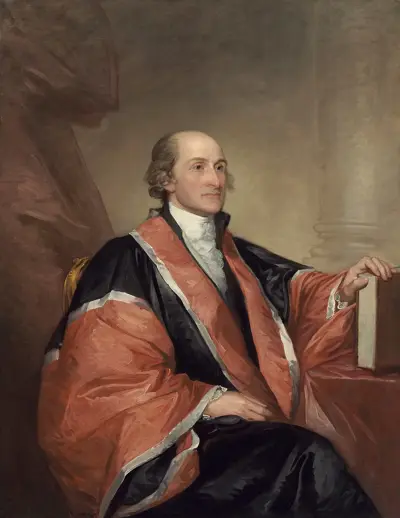
John Jay was an American statesman, patriot, diplomat, Founding Father, abolitionist, negotiator, and signatory of the Treaty of Paris of 1783. He served as the second Governor of New York and the first Chief Justice of the United States (1789–1795). He directed U.S. foreign policy for much of the 1780s and was an important leader of the Federalist Party after the ratification of the United States Constitution in 1788.
