Daniel Webster Quotes
Our Ancestors founded their government on morality and religious sentiment. They were brought hither by their high veneration of the Christian religion. They journeyed by its light, and labored in its hope. They sought to incorporate it with the elements of their society, and to diffuse its influences through all their institutions, civil, political, social, and educational.
The argument over whether or not the Founding Fathers intended a religious—Christian—foundation in the formation of America is not just a debate of modern times, but has been debated even in the next generation of politicians. Webster, believed that it was.
Daniel Webster, 1782-1852, U. S. Congressman (Federalist, NH & MA) & U. S. Senator (Federalist & Whig, MA), U. S. Secretary of State, Quoted in David McAllister, Principles of a Christian Political Science
Sourced by: Eigen's Political and Historical Quotations


Some other Republican governors thought that Fordice had misspoken and offered him a chance to correct or modify his statement. He declined.


Responding to criticisms by Rev. Jerry Falwell about America's moral decline: See also, Mark Russell


This quotation is sometimes used to show that Washington thought religion important. Most of the founding fathers thought religion both important and potentially dangerous. They had observed Europe tear itself apart over religious differences. Note that Washington uses the words “religious principles” as opposed to “religion” or “religious prescriptions” or “religious doctrine.” The founders were not hostile to the concept of religion—even Jefferson and Franklin saw potential values in religion and religious institutions. They were hostile, however, to letting any particular sect dominate the religious environment of the nation. Nor did they want any of the religions controlling or operating the civil government. See {625616}.


In the city of Narragansett, RI, there Lester York had each Christmas season dressed up as St Nicholas, 4TH century Catholic Bishop, the precursor to Santa Clause. He played the part of the Bishop and discussed Christmas in that context. The presentation was very educational as students could learn of the culture of that time but they also received an authentic religious sermon of the time. By inviting York into the public elementary schools, the students were learning some history and culture but they were also involved in a religious service and doctrine—the divinity of Christ. The former was good; the latter illegal as the public schools were in addition to educating historically communicating religious messages. York’s presentations had many supporters who had argued that York’s presentation conveyed Christian messages very well and children should not be denied that opportunity. After much community discussion, the public schools withdrew their invitation to York, and he gave his excellent presentation in many community churches.

It is hard to compromise on a position where advocates believe they are following God’s commandment. To compromise is to abandon God and morality. Issues like abortion, gay marriage, and prayer in public activities are examples of issues of seeming intractable resolution.


Objectors to the Separation of Church and State Doctrine point to this quotation to justify giving preferences to Christians in majority Christian societies and presumably to prefer Muslims in Islamic nations. Most of the Founding Fathers and most of the general population were on the opposite side of this issue. Hence the First Amendment was one of the conditions for ratification. There has always been a large minority who believe that America was founded by people who were mostly Christian (Protestant) and there is nothing wrong with having America be a Christian nation and preferring Christians for key government positions.

He was the only English Pope. The act of invasion had been sanctified earlier in Adrian’s Papal Bull. See {610518}. Henry’s invasion was successful but the occupation and reform was a disaster which has ramifications to this day.
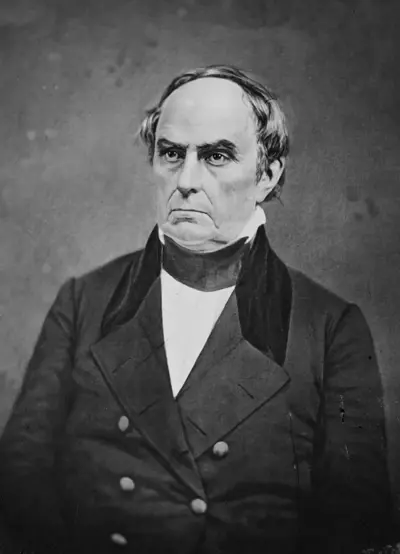
Daniel Webster was an American lawyer and statesman who represented New Hampshire and Massachusetts in the U.S. Congress and served as the U.S. Secretary of State under Presidents William Henry Harrison, John Tyler, and Millard Fillmore. As one of the most prominent American lawyers of the 19th century, he argued over 200 cases before the U.S. Supreme Court between 1814 and his death in 1852. During his life, he was a member of the Federalist Party, the National Republican Party, and the Whig Party.
